All posts by mspelmanlibrarian

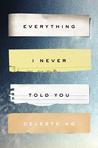
Everything I Never Told You by Celeste Ng (review by Ms. Stone, STEM teacher)

Everything I Never Told YouEverything I Never Told You by Celeste Ng
My rating: 4 of 5 stars

When high school junior Lydia turns up dead in the lake, every member of her bi-racial Chinese-American family examines the events in their communal life leading up to that moment. Vis-a-vis this fictional family, author Celeste Ng explores racist stereotypes about Chinese Americans. She also sheds light on the devastating effects of parental pressures on student academic performance. – Ms. Stone, teacher

View all my reviews

The Last Days of Night by Graham Moore (review by Connie M. ’17)

The Last Days of NightThe Last Days of Night by Graham Moore
My rating: 4 of 5 stars

When I picked up The Last Days of Night from the “free book” rack, I was doubtful of whether Graham Moore’s second novel would live up to the whirlwind Gilded Age adventure the back cover promised. However, the fact that this novel is based on, of all things, a patent lawsuit, impressed me all the more when I found myself completely absorbed in the incredibly intelligent and fast-paced plot. Moore skillfully paints his characters with depth and unique personalities, many of whom are well-known historical figures (Thomas Edison, Nikola Tesla, J.P. Morgan, etc.). I loved getting to know the eccentricities of these almost legendary people, and Moore periodically provides wonderfully profound insights into the way their minds operate. My only reservation is that Moore can sometimes overdo the most unique parts of his writing. For example, I found the quotes that he placed before each of the very short chapters more distracting than helpful, and his insights can occasionally be presented more subtly. Overall, The Last Days of Night was refreshing and exciting and would be a great read in particular for fans of historical fiction, law, or the history of inventions. – Connie M. ’17

View all my reviews

Crooked Kingdom by Leigh Bardugo (review by Amelia H. ’19)

Crooked Kingdom (Six of Crows, #2)Crooked Kingdom by Leigh Bardugo
My rating: 5 of 5 stars

Crooked Kingdom picks up the story where Six of Crows left off. The fight between the heroes and villains of Six of Crows finally culminates in an explosive finale. A fast-paced plot full of twists takes the reader on a whirlwind of a ride, moving at a breathless speed that makes every action and line of dialogue seem as if it’s happening in that moment for the first time. So much is packed in that the reader might feel daunted at the end of the first section, but everything links together into one cohesive narrative that ties up every loose thread it creates. The ending is as unforeseeable as it is thrilling, keeping the fast pace up till the last. This book was a perfect wrap-up to the Six of Crows duology. – Amelia H. ’19

View all my reviews

Black Square: Adventures in Post-Soviet Ukraine by Sophie Pinkham (review by Tiffany Z. ’17)

Black Square: Adventures in Post-Soviet UkraineBlack Square: Adventures in Post-Soviet Ukraine by Sophie Pinkham
My rating: 3 of 5 stars

Despite the subtitle, Black Square is not just about Ukraine. It is about the shrapnel the explosive nineties left in Russian and Ukrainian society, from the free travel of drugs that accompanied free borders, to Ukrainians’ struggle with their Soviet inheritance every Victory Day. Through anecdotes from Ukrainian and Russian colleagues and her own travels, Pinkham paints a portrait of Ukraine from the early 2000s to 2015 that, though vivid, falters in its attempt to illustrate a multifaceted society. Though she tries to cover all classes and regions in Ukraine, too often does she fall back on experiences with overwhelmingly young, artistic hipster types from Kyiv and western Ukraine. Some parts, like her discussion of the Donbas, almost entirely lack in-depth firsthand testimonies, even though those would have bolstered already interesting arguments rare in Western media. I wanted to see more like her coverage of the 2013-14 Maidan protests: though she did not attend them, she drew on rich historical contexts and personal interviews to represent the complex dialogue surrounding Ukrainian identity. Pinkham’s work sheds vital light on post-Soviet daily life, but I hesitate to extend Black Square from highly recommended for Russia-Ukraine aficionados to required reading for all. – Tiffany Z. ’17

View all my reviews

Fangirl by Rainbow Rowell (review by Amelia H. ’19)

FangirlFangirl by Rainbow Rowell
My rating: 3 of 5 stars

The title, Fangirl, refers to Cath, a fanfiction writer who begins the story by moving into her freshman dorm at the college. Off-balance because she and her twin sister Wren are no longer attached at the hip, Cath has to navigate her fiction-writing class and her relationships with her sister, father, roommate, and her roommate’s on-and-off boyfriend. Rowell’s characters initially seem to lack depth, but through their interactions and reactions they develop a uniqueness that brings them to life. While the story definitely has plot, some of the arcs are not explored to their full potential, such as the situation of Cath and Wren’s mother. I found the use of excerpts from Cath’s fanfiction quite effective–both as a way to inform the reader about the fictional book series Rowell has invented, and as a way to offer commentary within the story on the events that have occurred. Those who enjoy light-hearted romance and whimsical prose will enjoy this book.

View all my reviews

Zero to One by Peter Thiel (review by Anika B. ’18)

Zero to One: Notes on Startups, or How to Build the FutureZero to One: Notes on Startups, or How to Build the Future by Peter Thiel
My rating: 5 of 5 stars

In Zero to One, Peter Theil, the founder of Paypal, takes the reader through the steps of building a successful startup. A notable aspect of revolutionary companies is that they go from 0 to 1, as opposed to going from 1 to n. In other words, Microsoft went from 0 to 1 by creating new technology. However, the next Bill Gates will not build an operating system. I read this book on the plane, and only opened it because I couldn’t use my phone during takeoff. I had planned on watching a bunch of movies, but the book was so amazing that I did not put it down until I finished it. The book was very easy to read, and the text was accompanied by comprehensive visuals. The brilliant metaphors further helped the reader internalize the content. However, the best part of the book was the content itself. The book preaches the opposite of what is taught in the typical economic class, allowing the reader to consider the world from a different point of view. I recommend this book to everyone, and I believe that all Harker students should read it. – Anika B. ’18

View all my reviews

A Jury of Her Peers: American Women Writers from Anne Bradstreet to Annie Proulx by Elaine Showalter (review by Andrew R. ’17)

A Jury of Her Peers: American Women Writers from Anne Bradstreet to Annie ProulxA Jury of Her Peers: American Women Writers from Anne Bradstreet to Annie Proulx by Elaine Showalter
My rating: 3 of 5 stars

Ours is a young nation, and its literature is a young literature. But in A Jury of Her Peers: American Women’s Writing from Anne Bradstreet to Annie Proulx, feminist scholar Elaine Showalter profiles the enormous amount of progressive, boundary-pushing material that’s come out of America since the days of the Pilgrims. The writers featured in this encyclopedic book—more of a literary reference guide than a readable chronological account, although a few chapters are marked exceptions—tend to weigh toward the nineteenth century, with novelists like Harriet Beecher Stowe getting far more individual attention than the more modern women writers whose names come to mind when we think back on American literature. Civil War–era authors like Catherine Sedgwick may be in more dire need of recognition than better-known writers, but, with familiar names like Dorothy Parker and Flannery O’Connor on their way a few chapters later, it’s hard for the reader to stay invested in the dustier, more distant history of these early chapters. The core of the book is a long, engaging, and appealingly written dual portrait of Wharton and Cather. If Showalter had adopted this storytelling mode for the rest of the book, A Jury of Her Peers would have been not just informative but enjoyable, too. – Andrew R. ’17

View all my reviews

The Diabolic by S.J. Kinkaid (review by Anya W. ’20)

The Diabolic (The Diabolic, #1)The Diabolic by S.J. Kincaid
My rating: 3 of 5 stars

Kill in order to protect the person you’ve been created for. That is the duty of a Diabolic. To love their master for the entirety of their lives and be willing to do anything to protect them. In a time when a ruthless emperor reigns, that sacrifice can even extend to taking her place. If Nemesis is discovered, she’s dead, and Sidonia is in danger… Be it taking on a ruthless tyrant or allying with a mad prince, Nemesis will do whatever it takes to protect her master. The Diabolic is beautifully written and definitely falls into the YA category. The world building for this novel is absolutely brilliant, and personally, I’m a sucker for good world building. From the beginning, this novel is gripping, and although the quality of the story decreases somewhat near the end, this novel ends quite nicely. Speaking as someone who has been slightly phasing out of YA novels as of late, The Diabolic definitely deserves a read. – Anya W. ’20

View all my reviews

We Have Always Lived Here by Shirley Jackson (review by Andrew R. ’17)

We Have Always Lived in the CastleWe Have Always Lived in the Castle by Shirley Jackson
My rating: 5 of 5 stars

There’s a malicious presence in the Blackwood estate, the imposing structure on the outskirts of town inhabited by the only surviving members of a reclusive aristocratic family. It might be wheelchair-bound Uncle Julian, who constantly relives the day most of his family dropped dead of arsenic poisoning. It might be Constance, who hasn’t left the estate in six years and is fanatically devoted to the rules of etiquette. It might even be Merricat, the younger sister, who surrounds the estate with wards and totems to keep the rest of the world at bay. Jackson is best-known today for “The Lottery,” her horrifying story of small-town insularity gone wrong, but of all her notoriously creepy works this one deserves the most attention. Its suspense works in two directions: the reader discovers unsettling details about the past even as the narrative creeps toward a chilling climax, leaving the present moment doubly uncertain and doubly tense. The question of who sprinkled arsenic in the sugar bowl is pretty easily answered, but don’t be fooled—that apparent mystery is just a diversionary tactic to let more frightening revelations approach unnoticed. Even if horror isn’t your genre of choice, as Halloween approaches, Shirley Jackson’s novels are worth a try. – Andrew R. ’17

View all my reviews

Six of Crows by Leigh Bardugo (review by Amelia H. ’19)

Six of Crows (Six of Crows, #1)Six of Crows by Leigh Bardugo
My rating: 4 of 5 stars

Six of Crows is a fantasy heist story, with a cast of characters who practically spring off the page into real life and a world fleshed out to the tiniest detail. Bardugo’s gift for writing scenes and characters leaves readers feeling as if they themselves have followed the characters on their journeys step by step. Although the author spent considerable time setting up the main plot initially, after finishing the book, I could think of no unnecessary scenes or chapters. Everything came together in the final chapters of the book, which offered just enough closure to satisfy the reader but left enough unsolved that the reader has continue on to the sequel. If you like to immerse yourself in richly detailed fantasy worlds and carefully planned heists, this book is for you. Perfect for fans of The Lies of Locke Lamora. – Amelia H. ’19

View all my reviews