A Separate Peace by John Knowles (review by Andrew R. ’17)

A Separate PeaceA Separate Peace by John Knowles
My rating: 5 of 5 stars

A Separate Peace is such a refreshing change of pace, it deserves its own genre. Set at a boys’ boarding school in the final years of the World War II draft, it follows the powerful friendship and all-consuming rivalry between Gene and Phineas as the two students battle their teachers, the war, and each other. A Separate Peace is worth a read simply for its historical aspect—written in 1946, it chronicles the overlooked perspective of an adolescent during wartime, and its setting is as far as can be from Normandy and Auschwitz. But Knowles’s true mastery lies in his themes, deeply nuanced and constantly developed to more complex and enlightening forms, and by the end of Gene’s tale he has painted a beautiful portrait of conflict in any setting. A Separate Peace may make a perfect subject for an English essay, but at the same time its gravity and depth merit at least one read from any serious student of the Second World War. – Andrew R. ’17

View all my reviews

Cat’s Eye by Margaret Atwood (review by Elizabeth S. ’16)

Cat's EyeCat’s Eye by Margaret Atwood
My rating: 5 of 5 stars

Cat’s Eye details the life of stream-of-consciousness narrator Elaine as she reflects as an aged artist on her years growing up in the time after World War II in Toronto. Elaine has recently returned to Toronto in order to manage a retrospective gallery of her own critically acclaimed work. She reconnects with specters from her past, like the phantom Cordelia who tormented her as a child, whom she now sees and hears everywhere she goes even though she is long gone. Atwood captures Elaine’s apathetic, passerby-like thoughts and describes her world in the most visceral way, making her writing a true joy to behold as it brings the story to life. Atwood also uses Elaine as a lens through which she can explore her own judgments and thoughts about growing up as a girl through elementary, middle, high school, and university, finding love, hate, strength, and weakness in all of these events that seem so cataclysmic when undergone for the first time. Cat’s Eye is a true masterpiece, recommended to anyone for a more adult spin on a coming of age story.

View all my reviews

Wodehouse: A Life by Robert McCrum (review by Andrew R. ’17)

Wodehouse: A LifeWodehouse: A Life by Robert McCrum
My rating: 3 of 5 stars

20th-century humorist P. G. Wodehouse may have lived a life in which, by his own admission, “nothing really interesting happened, just meals and taking the dog for a walk,” but he still managed to leave behind countless thousands of pages of letters, articles, interviews, and fiction when he passed away in the 1970s—and it’s clear that dedicated biographer Robert McCrum has sifted through almost this entire mountain of material. Wodehouse: A Life is a tough read, not least because its quintessentially British subject gives rise to many quintessentially British references (Dickens; Eton; Lord Haw-Haw) that American readers would be hard-pressed to understand. Still, given the difficulty of studying a man whose ninety-four-year life was characterized mainly by dull monotony, McCrum has done a commendable job critiquing Wodehouse’s work and analyzing his thought processes in this nuanced look at the humorist’s history. I would recommend this biography not to hardened fans of Jeeves and Wooster, but to readers who are only beginning to delve into Wodehouse’s body of work; Wodehousian apprentices will likely be able to better interpret McCrum’s literary critiques as recommendations for their next humorous read. – Andrew R. ’17

View all my reviews

Delirium by Lauren Oliver (review by Catherine H. ’17)

Delirium (Delirium, #1)Delirium by Lauren Oliver
My rating: 3 of 5 stars

When love, or amor deliria nervosa, is seen as a disease, scientists develop a cure. However, the cure can only be administered when the patient is eighteen, otherwise it is unsafe. Lena Haloway, now Lena Tiddle, is eager to be cured so that she can’t become like her mother and sister, both previously infected. She’s worried about her friend Hana, who is beautiful and has recently begun riding the edge between loyal citizen and sympathizer. She forgets about this when her evaluations go horribly wrong and she meets a Cured named Alex. She falls in love and finally wakes up to reality, that love is not a disease, and that she must escape. Delirium had an interesting idea, and some nice romance, but I felt that the plot didn’t move smoothly throughout the book. – Catherine H. ’17

View all my reviews

The Shadowhunter’s Codex by Cassandra Clare (review by Catherine H. ’17)

The Shadowhunter's CodexThe Shadowhunter’s Codex by Cassandra Clare
My rating: 3 of 5 stars

The Shadowhunter’s Codex has no particular plot, but is similar to something such as Harry Potter’s Fantastic Beasts and Where to Find Them. The book explains the various tidbits of Nephilim culture among other things, with amusing notes from the characters of The Mortal Instruments series. A slow, but interesting read, one can learn about the weapons and types of Shadowhunters, as well as how to survive when dealing with Downworlders. I only recommend this book to avid fans of The Mortal Instruments or The Infernal Devices who have already finished the series. – Catherine H. ’17

View all my reviews

Dreams of Gods & Monsters by Laini Taylor (review by Maya V. ’17)

Dreams of Gods & Monsters (Daughter of Smoke & Bone, #3)Dreams of Gods & Monsters by Laini Taylor
My rating: 5 of 5 stars

The last book in its trilogy, Dreams of Gods and Monsters is a warming, heart wrenching, and fulfilling finale. After years of the chimaera and seraphim warring brutally against each other, the two races are devastated. The few chimaera monsters left are being resurrected regularly after losing battles. The seraphim race has split into two armies: one led by the new king, Jael, who plans to invade Earth, and another called the Misbegotten. In this sequel, Karou of the chimaera, the main character of this trilogy, and her love interest Akiva of the Misbegotten unite their races to defeat Jael. With their shared dream of uniting their people forever, they fight to bring harmony to the land of Eretz. This novel completes the epic trilogy with no questions unanswered. Every detail of the characters’ lives, the history behind the land of Eretz, and the mystery of the seraphim’s magical powers are explained magnificently. The interesting look into the side characters’ personalities makes the novel even richer with side stories and backgrounds. However, to thoroughly enjoy and appreciate this novel, it is vital to read the preceding two books. This title is a must-read for young adults! – Maya V. ’17

View all my reviews

Wintergirls by Laurie Halse Anderson (review by Elizabeth S. ’16)

WintergirlsWintergirls by Laurie Halse Anderson
My rating: 4 of 5 stars

Though intimidating because of its subject matter, Wintergirls yields a reward high enough at the end to make reading it well worthwhile. Anderson’s writing is always visceral and heartbreaking, but the harsh reality of eating disorders makes it even more gritty. When I was not transfixed by the story, I was admiring Anderson’s writing style and the perfect way that she captures the first person speaker, Lia. Lia’s best friend Cassie was recently found dead in a motel room of an overdose. The book details their past together, including Cassie’s bulimia (which eventually led to her downfalll), Lia’s anorexia, and the pact they made together when they were younger. Lia’s anorexia resurfaces, for the guilt that Lia feels about Cassie serves as a trigger. The author’s voice is strong in this book, with truly believable characters and a singular writing style. I recommend this book to any reader looking to really feel for a character and who isn’t at risk of being triggered by the subject matter. – Elizabeth S. ’16

View all my reviews

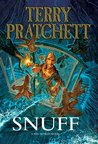
Snuff by Terry Pratchett (review by Andrew R. ’17)

Snuff (Discworld, #39)Snuff by Terry Pratchett
My rating: 2 of 5 stars

After starring in seven previous Discworld novels, it’s time for street urchin-turned-policeman-turned-nobleman Sam Vimes to take a vacation. But no reader will be surprised when Vimes uncovers a smuggling and trafficking business that’s thriving quietly in the countryside—after all, the policeman knows from years in the City Watch that everybody is guilty of something. Unfortunately, Snuff marks the degradation of some of the Discworld’s most complex characters. The city’s resident tyrant Vetinari, who in the past has embodied the role of the omniscient chessmaster, seems inexplicably to be losing his previously iron grip on his rule; meanwhile, Vimes’s butler Willikins, a nod to Jeeves from P. G. Wodehouse’s novels, has somehow morphed from the perfect “gentleman’s gentleman” to an unnecessary free-thinking, free-acting double of Vimes himself. And Vimes’s signature cynicism in believing that the policeman isn’t so very far removed from the criminal, while fresh six or seven novels ago, now feels stale and repetitive. So, while readers will recognize Pratchett’s style and wit in Snuff, those of us who have stuck with Vimes since Guards, Guards! so many books ago will find this novel uncomfortably familiar. – Andrew R. ’17

View all my reviews

The Silmarillion by J.R.R. Tolkien (review by Andrew R. ’17)

The Silmarillion (Middle-Earth Universe)The Silmarillion by J.R.R. Tolkien
My rating: 5 of 5 stars

“There was a lady Inzilbêth, renowned for her beauty, and her mother was Lindórië, sister of Eärendur, the Lord of Andúnië in the days of Ar-Sakalthôr father of Ar-Gimilzôr.” That kind of sentence, supersaturated with unpronounceable fantasy names that make even the most hardened Tolkien fan shudder, fills the entirety of The Silmarillion. This history of Middle-Earth, which Tolkien conceived decades before publishing The Lord of the Rings, is dense—so dense that I’m surprised the story doesn’t explode from the 300-page volume—I doubt I could have survived the whole thing without the aid of the index to remind me the difference between, for instance, Elwë and Olwë or Finarfin and Fingolfin. But despite the obvious difficulties (and there are many), The Silmarillion is easily the finest and most defining example of epic fantasy I’ve ever read, resplendent with mighty gods and thunderous battles. Yes, it requires a measure of patience and plenty of free time, and, yes, its target demographic is so small you have to squint to see it, but I hope a few battle-tested Tolkien fans will still be willing to give The Silmarillion a chance. – Andrew R. ’17

View all my reviews

The Drowned Cities by Paul Bacigalupi (review by Karen T. ’16)

The Drowned Cities (Ship Breaker, #2)The Drowned Cities by Paolo Bacigalupi
My rating: 4 of 5 stars

Built in the same world as Paolo Bacigalupi’s first book, Ship Breaker, The Drowned Cities follows the danger-ridden journeys of two children, Mahlia and Mouse, as the traverse the post-apocalyptic world of a multi-factioned civil war. As Mahlia and Mouse’s precarious existence in the small village of Banyan town is torn apart by the arrival of violent bands of soldier boys, they must find their own means of survival. Bacigalupi’s writing portrays the meaningless violence of war without trivializing it. Through the development of Mahlia’s conscience and the shifting of each character’s loyalties, Bacigalupi renders a cruel world that demonstrates the futility of war. A strong sequel to his first book, The Drowned Cities is definitely a worthy read for anyone who enjoys action and dystopian fiction. – Karen T. ’16

View all my reviews