Tag Archives: Andrew R. ’17

Americanah by Chimamanda Ngozi Adichie (review by Andrew R. ’17)

AmericanahAmericanah by Chimamanda Ngozi Adichie
My rating: 5 of 5 stars

Americanah bears all the hallmarks of the traditional epic story: between the protagonist Ifemelu’s emigration from Nigeria to the other side of the Atlantic, sparking a long process of depression, race-inspired musing, and eventual financial success, and her childhood friend Obinze’s thwarted attempt to make a life for himself in London, the novel encompasses all the heartbreak, alienation, and self-realization that characterizes the best epic novels. Chimamanda Ngozi Adichie has crafted a novel that handles a difficult topic—race relations, especially in the cultural interactions between African-Americans and non-American blacks—incisively and powerfully while refusing to pander to the reader’s opinions or reservations. Every character (and, given the prodigious heft of this novel, there are many) is treated with a rare mixture of sympathy and harsh honesty, resulting in a cast that strikes the reader as impressively human. Maybe the conclusion, when Ifemelu comes to terms with the personal changes her decade and a half of Americanization has wrought, trails off less powerfully than a novel of this magnitude deserves, but overall Americanah easily proved one of the best books I encountered all year: utterly convincing and unapologetic, the kind of book that it would be a shame to miss.

View all my reviews

Here’s Your Hat What’s Your Hurry by Elizabeth McCracken (review by Andrew R. ’17)

Here's Your Hat What's Your HurryHere’s Your Hat What’s Your Hurry by Elizabeth McCracken
My rating: 3 of 5 stars

One character stands out above all the rest in Elizabeth McCracken’s flamboyant collection of short stories: Aunt Helen Beck, an imposing and imperious wanderer who moves from stranger’s home to stranger’s home, masquerading as a long-lost relative until she is kicked back out onto the street. Judging by the vast array of circus sideshow performers, eccentric tattoo artists, and itinerant poets with handlebar mustaches on display in this collection, colorful characters are McCracken’s forte, and the supporting casts of each of the nine stories included here are really what give the collection its drive. Sometimes, as in the case of “Mercedes Kane” (an unsatisfying sketch about a middle-aged former child genius), the author’s tendency to prioritize characters over plot becomes tiresome; often, as with Aunt Helen Beck, the tradeoff is entirely worth it. Overall, just as with so many other short-story collections, the humorous genius of a few pieces is marred by their less impressive neighbors, and, like Aunt Helen Beck, Here’s Your Hat What’s Your Hurry is best picked up, briefly enjoyed, and then cast away once more.

View all my reviews

The Rape of Nanking: The Forgotten Holocaust of World War II by Iris Chang (review by Andrew R. ’17)

The Rape of NankingThe Rape of Nanking by Iris Chang
My rating: 3 of 5 stars

Iris Chang’s account of the Rape of Nanking, the month-and-a-half-long period of looting, barbarism, and murder after Japanese forces captured the then-capital of China in 1937, is the first book of its kind to be published in English. Part of the reason for this appalling lack of coverage of the massacre in the United States is that certain details, like the exact death count (somewhere in the hundreds of thousands), are still debated and may never be known for sure; Japanese officials’ ongoing reluctance to acknowledge the episode, as well as the intense pain associated with it for the families of all involved, have also prevented it from being intensely studied by American historians. Chang’s book, then, is enormously important in that it fills a gaping hole in the library of English-language studies of World War II, but that doesn’t mean I’d recommend it. The Rape of Nanking is painful to read, with its graphic descriptions of mutilation and abduction and its photos of the episode’s victims, alive and dead; the early chapters especially are as unpleasant and intense as they are informative. This is a brave book, an important book, but you should know what you’re getting into before you pick it up.

View all my reviews

Astonish Me by Maggie Shipstead (review by Andrew R. ’17)

Astonish MeAstonish Me by Maggie Shipstead
My rating: 3 of 5 stars

A ballerina smuggles a celebrated Russian dancer away from his Soviet handlers and into the United States, where they have a tempestuous love affair; later, said ballerina raises a dance prodigy who himself experiences some painful romance, while all the while minor characters around them (the neighbors, the owner of the ballet company, more haughty defectors from the USSR) fall in and out of their own miniature romantic dramas. As a novel primarily focused on the way dance shapes the lives of those who dedicate their souls to it, Astonish Me sometimes seems to be taking place onstage, what with its preoccupation with beauty and drama and tangled romantic threads, rather than in the Cold War-era society it tries to recreate. That said, though, Shipstead pulls off the intertwining love triangles at the novel’s center with impressive success, and the resolution brought about in the last few chapters feels satisfying without coming off as too neat or too overblown. Fans of ballet, and probably of the domestic drama as a genre, are certain to appreciate this book, but to the wider population the tendency of Astonish Me to prioritize aesthetics over real character development might not be entirely appealing.

View all my reviews

Wuthering Heights by Emily Bronte (review by Andrew R. ’17)

Wuthering HeightsWuthering Heights by Emily Brontë
My rating: 5 of 5 stars

In “The Glass Essay,” her long and brilliant verse meditation on aging and self-knowledge, the poet Anne Carson invokes the middle Brontë sister again and again as a parallel to her own experience: “I feel I am turning into Emily Brontë, / my lonely life around me like a moor, / my ungainly body stumping over the mud flats with a look of transformation / that dies when I come in the kitchen door.” On its surface, Wuthering Heights, Emily Brontë’s only novel, is a gothic romance: it follows the cruel and sinister Heathcliff and his consuming, almost maddening obsession with a childhood lover. But, for Carson and for me, it’s not the romantic tension that sets Wuthering Heights apart from all other eighteenth-century British novels—it’s the fog of gloom that pervades the book’s pages, from the somber, mist-shrouded moors where the story takes place to the towering tragedies that loom large in the protagonists’ destinies (and in Brontë’s own life). Unremitting gloom might not sound like a compelling backdrop to a romantic novel, but in the end it’s precisely that quality that makes Wuthering Heights linger in my mind in a way few other classics do.

View all my reviews

Sala by Toni Morrison (review by Andrew R. ’17)

SulaSula by Toni Morrison
My rating: 3 of 5 stars

I chose Sula as my first introduction to Toni Morrison’s work because it was slimmer, lighter, and—apparently—easier to understand than her more famous and acclaimed novels, but now that I’ve finished the last chapter I find myself wondering if this book is really representative of Morrison’s greater oeuvre. The plot sounds deceptively peaceful: young black Sula leaves her small hometown behind as she heads off to be educated, and upon her return ten years later (a significant gap in the novel’s chronology), she’s estranged and distrusted by her former friends. You can’t call Sula “peaceful,” though, because Morrison fills its pages with wanton, almost casual violence and death. A mother soaks her son’s mattress in gasoline and sets it alight; a woman burns to death trying to light a yard fire; a little boy slips from his friends’ fingers and falls into the lake, never resurfaces. Hard as I try, I can’t reconcile these near-constant, near-faceless deaths with the practices of “good novel-writing” that I’m used to, and so for the moment Sula seems more off-putting and grim than I’d wish. Maybe someday, when I’m more familiar with the rest of Morrison’s novels, I’ll be able to return to Sula and appreciate, or at least understand, its pervading sense of randomness and cruelty.

View all my reviews

Mr. Potter by Jamaica Kinkaid (review by Andrew R. ’17)

Mr. PotterMr. Potter by Jamaica Kincaid
My rating: 2 of 5 stars

Mr. Potter is the story of an illiterate Antiguan chauffeur whose father was long-gone by the time of his birth, whose mother drowned herself when he was still a young child, whose clients are disdainful of his social status and the color of his skin, and whose illegitimate daughters are strangers to him because he abandoned every one of them, just as his own father abandoned him. One of these daughters narrates this novel from a distance—a distance of time, since her father died years prior (we watch her visit his grave), but also an emotional distance that causes her to treat him with a mixture of pity and contempt and guarded affection. The best one can say about Mr. Potter as a novel is that it’s lyrical; in fact, it takes lyricism and extends to an almost illogical extreme. In the interests of lyricism, then, our narrator repeats the same facts and phrases five or six times in the same sentence. “Mr. Potter was my father, my father’s name was Mr. Potter,” she tells us at least once every chapter. It’s an interesting technique, certainly, and one that lends a certain power to this novel, but more often than not it turns Jamaica Kincaid’s otherwise impressive prose into a sticky morass.

View all my reviews

The Haunting of Hill House by Shirley Jackson (review by Andrew R. ’17)

The Haunting of Hill House The Haunting of Hill House by Shirley Jackson
My rating: 4 of 5 stars

No one who’s read Shirley Jackson’s short story “The Lottery” is likely to forget it anytime soon: even sixty-five years after its explosive debut, the narrative of sinister small-town ritualism retains an impressive staying power that makes it as jarring to modern readers as it was to its original audiences. Shirley Jackson draws on the same arsenal of subtly suspenseful plot devices in her 1959 novel The Haunting of Hill House, in which the scarred and unstable Eleanor Vance joins a research party to live in a crumbling Victorian mansion for the summer. Part Edgar Allen Poe and part Henry James, this psychological ghost story isn’t quite a horror novel, at least not in the Stephen King sense; its terror, as in “The Lottery,” is so understated that the full force of the book’s scariest scenes isn’t likely to manifest itself until days after you’ve read them. (From what I’ve heard, Jackson’s last novel, We Have Always Lived in the Castle, ramps up this creepiness to an even more intense and chilling pitch.) For a haunted-house story, this novel is very strong, and rates only one notch below “The Lottery” in its quality and spine-tingling effect.

View all my reviews

Rook by Sharon Cameron (review by Andrew R. ’17)

RookRook by Sharon Cameron
My rating: 4 of 5 stars

There are only so many post-apocalyptic dystopia concepts that exist in the world, and, thanks to the mad rush of YA science fiction sprang into being following the enormous success of The Hunger Games, it’s almost—almost—impossible at this point for an author to come up with a brand-new one. In Rook, however, Sharon Cameron may just have pulled it off. The world that protagonists Sophia Bellamy and René Hasard inhabit is full of not-so-subtle overtones of the French Revolution, with lower-class mobs overrunning the Upper City and a massive, blood-spattered blade decapitating enemies of the state. But this isn’t eighteenth-century Paris—this is Europe hundreds of years after the polar shift that wiped out most of humanity. The loss of all pre-apocalypse technology has forced society to backtrack several centuries to a bloodier and more brutal time. The characters are almost as interesting as the setting—Sophia may be a classic YA heroine fighting off the advances of two devilishly handsome suitors, but at least the love triangle has some political intrigue to spice things up. (Nearly all the characters are benevolent criminals of some sort.) Rook is lengthy, but readers will forgive its heft once they get caught up in the engaging narrative and well-conceived setting.

View all my reviews

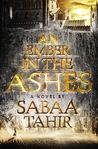
An Ember in the Ashes by Sabaa Tahir (review by Andrew R. ’17)

An Ember in the Ashes (An Ember in the Ashes, #1)An Ember in the Ashes by Sabaa Tahir
My rating: 1 of 5 stars

The Hunger Games. Eragon. Star Wars. Odds are you’re already perfectly familiar with these stories, in which case there is no reason for you to pick up Sabaa Tahir’s new novel. For me, An Ember in the Ashes reads like a half-hearted cut-and-paste of all the fantasy/sci-fi books that came before it, an unapologetic catalog of tired genre clichés—romantic tension! teenagers fighting to the death! orphaned protagonists! unimaginative fantasy names! faceless demonic warlords!—without a single page of original material. Faced with such an apparent lack of inspiration, the author repeats her ideas and plot points thirty times throughout the book. That’s standard practice with many YA authors, unfortunately, when it comes to romance (“Does he love me or doesn’t he?”), but it gets downright tiresome when we have to hear this sentence repeated ad nauseam: “As my grandmother always told me, ‘Where there’s life there’s hope.’” According to the American Library Association, there are approximately 5,000 YA books published per year, and I can safely list (without much exaggeration) about 4,999 new books that are more worth your time than this one. I was not a fan.

View all my reviews