Tag Archives: Andrew R. ’17

Not a Penny More, Not a Penny Less by Jeffrey Archer (review by Andrew R. ’17)

Not a Penny More, Not a Penny LessNot a Penny More, Not a Penny Less by Jeffrey Archer
My rating: 2 of 5 stars

When a millionaire pulls off an elaborate scheme to steal money from other millionaires, it’s up to the conned millionaires to chase the criminal millionaire around to all his high-society haunts so that they can surreptitiously extract their fortunes from him and become millionaires once more. As a non-millionaire, it’s hard to sympathize with all these fabulously wealthy characters whose most important traits are their holdings in African gold and their prize-winning orchid collections. Archer is wedded to elaborate scene descriptions, from the exact years of every expensive bottle of wine the characters enjoy to the brand and tailor of each of their suits. To provide these details, Archer often draws a little too far on his narrative omniscience. By the fifth chapter, he’s revealed all but one plot twist in the entire novel, leaving the reader to tag along on the protagonists’ journeys to Wimbledon and Monte Carlo without caring too much who will succeed and who will fail. Not a Penny More, Not a Penny Less is a good fit for readers who share the author’s penchant for finances, but at 300 pages, the novel isn’t prepared to offer much else. – Andrew R. ’17
View all my reviews

House and Fire by Maria Hummel (review by Andrew R. ’17)

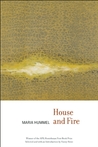
House and FireHouse and Fire by Maria Hummel
My rating: 4 of 5 stars

The poems collected in Maria Hummel’s House and Fire present emotions and dreams in their purest and least inhibited forms. Drawing from a huge variety of poetic forms, from archaic structures like the ghazal (a form of ancient Arabic verse) and the villanelle to sprawling free-verse constructions that span several pages, these pieces revolve around a single theme: the confused and frightened emotions of a mother whose infant son is slowly dying on a hospital bed. The narrative is all the more powerful because Hummel, a mother herself, has suffered through the same trying times as her narrator. With brutal self-reflection and honesty slathered unabashedly across its pages, House and Fire draws on the full potential of the poetic genre to transfer ideas straight from the writer to the reader. Even the most enigmatic and complex of Hummel’s poems will fill poets and non-poets alike with the raw emotion of the speaker and of the author herself.

View all my reviews

Wodehouse: A Life by Robert McCrum (review by Andrew R. ’17)

Wodehouse: A LifeWodehouse: A Life by Robert McCrum
My rating: 3 of 5 stars

20th-century humorist P. G. Wodehouse may have lived a life in which, by his own admission, “nothing really interesting happened, just meals and taking the dog for a walk,” but he still managed to leave behind countless thousands of pages of letters, articles, interviews, and fiction when he passed away in the 1970s—and it’s clear that dedicated biographer Robert McCrum has sifted through almost this entire mountain of material. Wodehouse: A Life is a tough read, not least because its quintessentially British subject gives rise to many quintessentially British references (Dickens; Eton; Lord Haw-Haw) that American readers would be hard-pressed to understand. Still, given the difficulty of studying a man whose ninety-four-year life was characterized mainly by dull monotony, McCrum has done a commendable job critiquing Wodehouse’s work and analyzing his thought processes in this nuanced look at the humorist’s history. I would recommend this biography not to hardened fans of Jeeves and Wooster, but to readers who are only beginning to delve into Wodehouse’s body of work; Wodehousian apprentices will likely be able to better interpret McCrum’s literary critiques as recommendations for their next humorous read. – Andrew R. ’17

View all my reviews

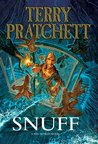
Snuff by Terry Pratchett (review by Andrew R. ’17)

Snuff (Discworld, #39)Snuff by Terry Pratchett
My rating: 2 of 5 stars

After starring in seven previous Discworld novels, it’s time for street urchin-turned-policeman-turned-nobleman Sam Vimes to take a vacation. But no reader will be surprised when Vimes uncovers a smuggling and trafficking business that’s thriving quietly in the countryside—after all, the policeman knows from years in the City Watch that everybody is guilty of something. Unfortunately, Snuff marks the degradation of some of the Discworld’s most complex characters. The city’s resident tyrant Vetinari, who in the past has embodied the role of the omniscient chessmaster, seems inexplicably to be losing his previously iron grip on his rule; meanwhile, Vimes’s butler Willikins, a nod to Jeeves from P. G. Wodehouse’s novels, has somehow morphed from the perfect “gentleman’s gentleman” to an unnecessary free-thinking, free-acting double of Vimes himself. And Vimes’s signature cynicism in believing that the policeman isn’t so very far removed from the criminal, while fresh six or seven novels ago, now feels stale and repetitive. So, while readers will recognize Pratchett’s style and wit in Snuff, those of us who have stuck with Vimes since Guards, Guards! so many books ago will find this novel uncomfortably familiar. – Andrew R. ’17

View all my reviews

The Silmarillion by J.R.R. Tolkien (review by Andrew R. ’17)

The Silmarillion (Middle-Earth Universe)The Silmarillion by J.R.R. Tolkien
My rating: 5 of 5 stars

“There was a lady Inzilbêth, renowned for her beauty, and her mother was Lindórië, sister of Eärendur, the Lord of Andúnië in the days of Ar-Sakalthôr father of Ar-Gimilzôr.” That kind of sentence, supersaturated with unpronounceable fantasy names that make even the most hardened Tolkien fan shudder, fills the entirety of The Silmarillion. This history of Middle-Earth, which Tolkien conceived decades before publishing The Lord of the Rings, is dense—so dense that I’m surprised the story doesn’t explode from the 300-page volume—I doubt I could have survived the whole thing without the aid of the index to remind me the difference between, for instance, Elwë and Olwë or Finarfin and Fingolfin. But despite the obvious difficulties (and there are many), The Silmarillion is easily the finest and most defining example of epic fantasy I’ve ever read, resplendent with mighty gods and thunderous battles. Yes, it requires a measure of patience and plenty of free time, and, yes, its target demographic is so small you have to squint to see it, but I hope a few battle-tested Tolkien fans will still be willing to give The Silmarillion a chance. – Andrew R. ’17

View all my reviews

For the Win by Cory Doctorow (review by Andrew R. ’17)

For the WinFor the Win by Cory Doctorow
My rating: 4 of 5 stars

On the one hand, For the Win reads like a video game ad. Cory Doctorow describes, with childlike delight, his ideas for massive multi-player online role-playing games with titles like “Svartalfheim Warriors” and “Zombie Mecha” in such painstaking detail that the reader has to wonder why he chose a career as a novelist instead of a game designer. But then the other face of the book shows itself, the professional, educational side that balances out Doctorow’s nerdy fantasies with lessons on economics, of all things. At first, pairing unions and finance with video games seems an odd strategy, but when Doctorow starts drawing parallels between the two, the offline world he’s created is fleshed out as fully as his online ones. There are characters, mostly impoverished gold farmers and corrupt businessmen; there’s a plot, even if it only appears between video game descriptions and economics lessons. But the real meat of the book, the part that Cory Doctorow fans old and new will recognize as part of the author’s style, has nothing to do with the characters or plot. Rather, all the substance lies in novel’s empowering message, its inspiring moral about equality, freedom—and video games. Andrew R. ’17

View all my reviews

Plague by Michael Grant (review by Andrew R. ’17)

Plague (Gone, #4)Plague by Michael Grant
My rating: 1 of 5 stars

By the beginning of the fourth book of Michael Grant’s FAYZ series, the situation is grim: deadly epidemics sweep the population, young children resort to cannibalism to survive, an invincible sadistic demon prowls the streets, mutant insects lay eggs inside humans so their larvae can gnaw their way free upon birth…If this description of events makes this book sound over-the-top gruesome, that’s because it is. Grant forgoes any semblance of a plot in favor of graphic death after graphic death, introducing scores of characters whose sole purpose is to be eaten or burnt or flayed or stabbed, and he often undercuts the horror of his plot by going too far with his ideas. Sure, wasps with bulletproof carapaces that can gnaw through stone are scary enough, but making them the size of minivans and perching undead whip-wielding demons on their shoulders is such absurd overkill as to make them seem ridiculous, not frightening. I could go on about the story’s repetitiveness, its clichéd characters, its depressing love interest, or its awful attempts at humor, but I’ll have to be content with warning potential readers that the FAYZ takes a serious turn for the worse at this point in the series. – Andrew R. ’17

View all my reviews

Jim Henson: The Biography by Brian Jay Jones (review by Andrew R. ’17)

Jim Henson: The BiographyJim Henson: The Biography by Brian Jay Jones
My rating: 4 of 5 stars

“Jim Henson” never quite became a household name, but his creations are known across the world: Kermit, Miss Piggy, Big Bird, the Great Gonzo…This biography, however, isn’t the story of the Muppets or Sesame Street, and it’s not a list of the wildly successful movies Henson produced in his day. Accomplished biographer Brian Jay Jones paints a picture of the man who launched some of the 20th century’s most successful ventures in entertainment, tracking his rise from madcap coffee advertisements to the creation of the “Muppet Show,” and even beyond, with films like Labyrinth and The Dark Crystal. Jones has done his research well, and the book’s pages are scattered liberally with wistful insights from Henson’s children, friends, and coworkers. Most remarkably, the book’s atmosphere is light and readable, a tribute to Henson’s love of simplicity and entertainment. Any reader with time to spare should pick up Jim Henson: The Biography—not because it’s an insightful or meaningful experience, just because it’s a fun look into the life and legacy of a this astoundingly creative man. – Andrew R. ’17

View all my reviews

Aunts Aren’t Gentleman b P.G. Wodehouse (review by Andrew R. ’17)

Aunts Aren't Gentlemen (Jeeves, #15)Aunts Aren’t Gentlemen by P.G. Wodehouse
My rating: 4 of 5 stars

In Aunts Aren’t Gentlemen, Bertie Wooster and his butler Jeeves, the heroes of fourteen preceding Jeeves and Wooster novels, find themselves embroiled (as usual) in several ridiculous conflicts, all thanks to the meddling of Bertie’s overbearing Aunt Dahlia (also as usual). Not only does Aunt Dahlia want Bertie to sabotage a horse-race so she can beat her rivals in a bet, she also wants him to kidnap a cad from under the nose of one of his many ex-fiancées, Vanessa Cook—who, incidentally, is currently engaged to a brawny Communist with a violent temper who is all too eager to turn Bertie inside out if he catches him in the same room as his lover. Anyone who’s enjoyed more than one or two Wodehouse novels will have noticed that they all follow the same formula; the author discovered early on that mixing one aunt, one fumbling narrator, two to three marriage proposals, and at least five aggressive, beefy rivals will always result in comedy. But even though Aunts Aren’t Gentlemen is nothing new, it showcases Wodehouse’s signature wit and cheekiness—and, in the end, isn’t that all that really matters in a Jeeves and Wooster novel? – Andrew R. ‘17

View all my reviews

1491: New Revelations of the Americas Before Columbus by Charles C. Mann (review by Andrew R. ’17)

1491: New Revelations of the Americas Before Columbus1491: New Revelations of the Americas Before Columbus by Charles C. Mann
My rating: 2 of 5 stars

1491 is not for everyone. An ambitious outline of Native American history and accomplishments before Columbus’s landing, it intentionally lacks any hint of characters or plot. Instead, sandwiched between 200 pages of introductions, conclusions, and appendices is a dense pile of evidence and analysis, all supporting a single thesis: that Native American societies were bigger, older, and more complex than historians once thought. And Mann proves his point beyond a shadow of a doubt, citing legions of professors, archaeologists, anthropologists, and even a few botanists whose opinions match his own. So 1491’s problem is not one of credibility—the challenge with this book is that very few readers will feel interested enough to slog all the way through it. Occasional anecdotes about historical figures like Tisquantum, the so-called “Friendly Indian” from the Pilgrim legends, add some engaging material, but these are so few and far between that there can’t be more than six or seven of them in the entire tome. I would only recommend 1491 to readers with lots of free time and long attention spans. Although I can’t deny the educational value of this book, I don’t intend to take on Mann’s companion work, 1493. – Andrew R. ‘17

View all my reviews