Tag Archives: Illness

Dream of the Red Chamber By Cao Xueqin (Review By Jason S. ’25)

Dream of the Red ChamberDream of the Red Chamber by Cao Xueqin
My rating: 4 of 5 stars

“The Dream of the Red Chamber is a peculiar novel to write a review for. I’ve been reading it on-and-off over the course of the last three months, and I’ve had to reread my favorite sections to really collect my thoughts. In reflecting, I’ve come to the conclusion that the novel is pretty worthwhile.

For the uninitiated, The Dream of the Red Chamber is an 18th-century Qing Chinese novel, among the Four Great Classical Novels of Chinese literature. In the frame narrative, a humble primordial stone begs a Buddhist monk and a Taoist priest to help him experience the pleasures of the mortal “red dust.” The stone is thus incarnated as the pampered heir Jia Baoyu, who cultivates a doomed love for his cousin Lin Daiyu in the pleasurable Daguanyuan garden and navigates the declining fortunes of four aristocratic families. Due to my limited knowledge of Chinese, I elected to read Chi-chen Wang’s translation using the Wade-Giles romanization (I will refer to the characters in pinyin). Although Wang ultimately abridged the 120-chapter novel into 40 chapters and removed much of the poetry and nuance introduced by Cao, I found his adaptation to be suitable for a first read-through where those details would have been inevitably glossed over anyways.

The story reads in an almost episodic fashion, with various courtly vignettes informing an overall metanarrative of societal decline. Due to this structure, most of the characters in this novel are static, and as the novel progressed, quickly made themselves unlikeable to me, either through their actions or ignorance. Baoyu, our protagonist, was a prime example. His petulance, passivity, lust, and hedonism deeply frustrated me as the troubles of his family became clearer. In fact, at times he literally sits and stares catatonic as events unfold around him. Don’t mistake this for a negative, though — his inability to take responsibility enhanced for me the message that all pleasure regresses into dust, and a certain turning point in the middle of the book made me feel really sorry for him. The only characters I could truly root for were the truly innocent who underwent horrible psychological and physical abuse at the hands of others, usually female servants victimized by either Baoyu’s ignorance or the Macchiavellian antiheroine Wang Xifeng.

My main criticism is with the pacing. Perhaps it is a consequence of Wang’s effort to compress 120 chapters into 40, but I found myself incredibly confused as to who was who. It took me a solid few minutes with a family tree online to truly understand the complex relationships between the four families. I’d sometimes start reading a chapter and give up halfway through because I didn’t know who any of the characters were, which really hurt the episodic nature of the text and made it harder to connect with the characters. It wasn’t a huge issue, though. In my opinion, all that means is that this text will take extra effort to digest.

I want to end this review by talking about the ending (in a spoiler-free way). The thing is, it completely contradicts everything that’s been established about the characters, and subverts the overarching narrative Cao was building up. Yet it contained some of the most beautiful literature I had the pleasure of reading in the book. Puzzled, I sleuthed online and learned quickly that the last 40 chapters of the original 120 had been written by an unknown author with completely different intentions from Cao. In other words, for the last third of the book, I too was a captive of the “red dust,” too blinded by the feel-good writing to question its authenticity. Yet I maintain that the ending is beautiful, and I think its dubious authorship enhances its value. Is Baoyu’s happy conclusion illusory by necessity? This is a question I hope to revisit upon future examinations of this text later in life. The truth is that we will never know, and accepting that fact is our first step to abjuring the red dust.”

View all my reviews

The Wings By Yi Sang (Review By Jason S. ’25)

The WingsThe Wings by Yi Sang
My rating: 5 of 5 stars

Want to see a Korean take on bite-sized psychologically gripping novellas like The Stranger and The Metamorphosis? Look no further than The Wings, by the early 20th century modernist Yi Sang.

These comparisons are of course not made to suggest that Yi is derivative in any way. Rather, it is a testament to the sheer amount of pain and alienation Yi can convey in as little as 40 pages. The story follows an unnamed 26 year-old narrator who is completely ignorant of human society. Manipulated by his wife Yeonsim, he languishes in the darkness of his room and accepts the vast inequality between his and Yeonsim’s lifestyle. Nevertheless, he wonders what her occupation is, and his attempt to learn more about her and humanity has tragic consequences.

While reading through the novella, I was struck by the childlike naïveté with which our narrator approaches the world. For instance, he concludes from his observations that the reason people exchange coins is that there is some pleasure inherent to bartering, and becomes immensely happy just from giving Yeonsim some coins. This simplicity makes his eventual loss of innocence even more crushing as we attempt to piece together Yeonsim’s circumstances.

I also found it incredibly interesting to read The Wings in the context of Yi’s life. Without giving too much away, The Wings is a semi-autobiographical piece of literature and mirrors Yi’s own relationship with his wife, who had an occupation he was deeply ashamed of. In addition, Yeonsim’s treatment of the narrator parallels the colonial Japanese oppression of the Korean identity, and Yeonsim’s occupation ends up being incredibly relevant to Japanese abuses of power during Yi’s lifetime.

The Wings manages to pack raw emotion and several layers of analysis into 40 pages. It’s no wonder many Korean high school curricula teach it to this day. I highly recommend it.

If you enjoyed The Wings, I’d highly suggest checking out Osamu Dazai’s novel No Longer Human, which I’ve reviewed on the Book Blog! It is similarly a bite-sized semi-autobiography, written by an Asian author in the proximate context of Japanese imperialism, and touches on themes of an alienated individual attempting to understand society.

As previously alluded to, The Stranger by Albert Camus and The Metamorphosis by Franz Kafka are also nice bite-sized novellas about people alienated for either their psychology or physical form. Bonus points to The Stranger to also having a colonial context.

And lastly, if you enjoy experiencing narratives through microtransaction-light video games, I suggest looking into Limbus Company. It’s a Korean-developed gacha RPG available for free on Steam and mobile with characters from literature such as Meursault (The Stranger), Gregor Samsa (The Metamorphosis), Yi Sang himself, and more. Surprisingly deep story, and it’s always fun to watch Heathcliff from Wuthering Heights beat up Don Quixote.

View all my reviews

No Longer Human by Osamu Dazai (5 Star Review by Jason S. ’25)

No Longer HumanNo Longer Human by Osamu Dazai
My rating: 5 of 5 stars

TW: suicide, substance abuse, misogyny

No Longer Human, Osamu Dazai’s last work, is a heavy semi-autobiographical novel told mostly through the abandoned memoirs of Oba Yozo, a man whose failure to understand and properly interact with a thoroughly westernized pre-WWII Japanese society forces him to live under the assumption that he is disqualified from humanity. The narrative is bookended by an observer whose findings reframe Yozo’s life through a set of more forgiving, though by no means rose-tinted, lenses.

I find Yozo to be an incredibly well-written character. This does not mean that I like him as a person; on the contrary he is melancholy, irresponsible, and thus extremely difficult to like. However, his mistakes are painfully human. This being said, Yozo’s narration is at times dominated by an unusual misogyny that uncomfortably extends beyond the already alienating context of his misanthropy. Even more concerning for a semi-autobiographical novel, quite a few women are written by Dazai to passively conform to Yozo’s views concerning a vulnerable, inscrutable woman.

This intolerance, though, is a human fault. Inexcusable, but quietly human. Passing judgements onto Yozo’s faults inevitably made me question my own. The text, though genuinely depressing, sits at an extremely accessible 177 pages. No Longer Human is a novel I will return to when my values will have unrecognizably shifted, and one that I recommend best with a highlighter, a good pen, and an open mind. —Review by Jason S. ’25

Jason’s book recommendations for those who enjoyed No Longer Human:

Notes from the Underground is a strikingly similar work; indeed, Dazai even explicitly communicates his Dostoevsky influences at one point in No Longer Human.

Siddhartha is a very interesting piece in comparison.

Brief Interviews with Hideous Men explores many of the same issues in radically different contexts, particularly the story “The Depressed Person.”

View all my reviews

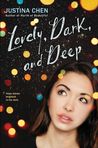
Lovely, Dark, and Deep by Justina Chen (review by Anya W. ’20)

Lovely, Dark, and DeepLovely, Dark, and Deep by Justina Chen
My rating: 3 of 5 stars

Viola Li has a Plan. After the end of her first trip with her aunt, to Africa, she’s working on several more bake sales to raise money for the causes she’s written about. A few more of her scheduled vacations, and she’ll have just the right resume for acceptance as a journalism major to her dream school in Dubai.
Except, as it turns out, sometimes the malaria vaccine can give you extreme, permanent, photosensitivity. Thanks to her professional disaster manager parents, Viola’s entire life and all her plans for the future are permanently deconstructed within a week. All that’s left now is figuring out how to cope.

Chen’s novel is a good beach read, and typical YA. The romance, while not badly-written, is not particularly epic-it would have had the same impact as a friendship. However, her writing is excellent at evoking empathy within the reader, and breathes life into her main characters.
-Anya W. ’20

View all my reviews

Skyscraping by Cordelia Jensen (review by Anya W. ’20)

SkyscrapingSkyscraping by Cordelia Jensen
My rating: 3 of 5 stars

Mira doesn’t know what she would call a major turning point in her life. Was it the walk when she decided that this year’s yearbook theme would be New York City? Was it the day she found her father in bed with his TA? Was it the day when she found out about her parent’s open marriage? Was it the day she found out that her family had no time left?

At some point though, Mira shut down, and she can’t-isn’t-won’t ever be the same again.

Jensen’s novel written in free prose is a heart wrenching expose on the beautiful, terrible mess we call family. She writes unflinchingly of parents’ mistakes and the intolerance of youth, and manages to still infuse it all with a sense of understanding, and of the importance of acceptance and compromise. I love how dynamic her main character is, and how Jensen still allows the side character be multifaceted, with their own emotions and goals. While some plot points may seem trite, they are at least comparatively minor. This is a good, solid read that won’t leave you feeling like you wasted your time. – Anya W. ’20

View all my reviews

Pandemic (The Extinction Files Book #1) by A.G. Riddle (review by Saloni S. ’21)

Pandemic (The Extinction Files #1)Pandemic by A.G. Riddle
My rating: 4 of 5 stars

Bioterrorism. We’ve read about it in the news, heard from the TV anchors, but have we truly understood the plausibility of a global pandemic from a bioterrorist attack?

In the seven hundred page science fiction novel Pandemic, the first book in the Extinction series, author A.G. Riddle explores our vulnerability to a pandemic in an interconnected, global world; Conner McClain, head of a group of scientists known as “the Citium”, releases a deadly viral strain deep into the heart of the developing countries of Africa. While these events are taking place, protagonists Desmond Hughes, who is struggling to regain his memories, and Peyton Shaw, an epidemiologist at the CDC, scramble to find the cause and cure of this outbreak before it takes even more lives. This well-researched novel takes us deep into the world of the epidemiologists and public health workers who place themselves in danger in order to save the lives of others.

As the disease spreads across continents infecting and killing millions, Shaw and Hughes unveil treacherous secrets hidden deep inside the core of the Citium and tirelessly work to save the human race and to apprehend the criminals behind this deadly attack. Throughout this engaging novel, Riddle combines science and historic facts with the thrill of an action-packed story, further enthralling the reader. By alternating among different characters’ points of view, the author intimately communicates the heart-wrenching emotions from each stunning revelation, drawing the reader deeper into the storyline. You won’t be able to put this book down.

I read Pandemic on a plane and definitely enjoyed it more than watching movies; the book also makes one appreciate the importance of research and resources invested in the early identification of pathogens and response mechanisms. Overall, Pandemic is a great story and I would definitely recommend this book to a reader who wishes to read an enthralling, informative science fiction novel. I am eagerly looking forward to reading the next book in the series, Genome, which will be released in October this year! – Saloni S. ’21

View all my reviews

Lock In by John Scalzi (review by Catherine H. ’17)

Lock In (Lock In, #1)Lock In by John Scalzi
My rating: 4 of 5 stars

John Scalzi’s Lock In introduces the reader to a world in the near future where millions of people have been affected by a virus that immobilizes the body but leaves the brain fully functional, while others have had their brains altered but still have fully functional bodies. Those who are immobilized are “locked in” and can use “threeps,” or robotic bodies, to interact with others in the physical world; those who have had their brain chemistry changed but have had no other physical effects are called Integrators and can allow those who have been “locked in” to borrow their bodies for a time. Hadens, those who have lost the ability to use their bodies due to this virus, find themselves in a new community that can exist outside of the physical realm, because they are not attached to their bodies. Scalzi does some interesting world-building and purposefully leaves the protagonist, Chris Shane, ambiguous. For example, Chris’s gender and race are hardly mentioned, which leaves the reader to interpret how Chris interacts with the world as an FBI agent looking to solve a murder that may have involved Hadens. I appreciated Scalzi’s subtle inclusion of diversity in the novel, and I look forward to reading more from him.

View all my reviews

Into the Valley by Ruth Galm (review by Jacqueline H. ’18)

Into the ValleyInto the Valley by Ruth Galm
My rating: 4 of 5 stars

Into the Valley is a debut novel by Ruth Galm that chronicles the adventure of B., a thirty year old woman who wanders through 1970s California, trying to assuage a “carsickness” that plagues her thoughts. B. is unable to cope with the coarseness of the present world, yet rejects the traditional binds of the past. This tension is an interesting dichotomy throughout the novel, although it is never resolved at the end. The ending was surprising, but it left me hanging. Into the Valley reminds me more of a collection of individual narratives than a cohesive plot. Nevertheless, the novel was beautifully written and I found it hard to put down. The characterization of B. is excellent – the author represents her as an eccentric and neuroatypical itinerant. Written in raw, haunting prose, Galm’s exceptional use of unreliable narration and stunning portrayal of California in the 1970s leaves an indelible mark in the reader’s mind. I would recommend this book to anyone craving a dreamy, existential read.

View all my reviews

Doomsday Book by Connie Willis (review by Connie M. ’17)

Doomsday Book (Oxford Time Travel, #1)Doomsday Book by Connie Willis
My rating: 5 of 5 stars

Doomsday Book, Connie Willis’s first Oxford Time Travel novel, is one of her most famous, featuring young time traveler-historian Kivrin on an expedition to medieval England. Shifting between modern and medieval times, the novel combines first person “journal” accounts and traditional narration. Like many of Willis’s novels, Doomsday Book is (in comparison) relatively slow moving for a good half of the book (though certainly not uninteresting) and speeds up to an incredibly moving ending. The book makes the horrors of the Black Death devastatingly real, and continuously questions the role of religion in our lives. While perhaps more interesting to those who have some background on the middle ages, I had little interest in medieval times but still found the book hauntingly captivating. I found myself pondering Doomsday Book for days after I had finished reading it.

View all my reviews

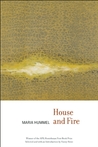
House and Fire by Maria Hummel (review by Andrew R. ’17)

House and FireHouse and Fire by Maria Hummel
My rating: 4 of 5 stars

The poems collected in Maria Hummel’s House and Fire present emotions and dreams in their purest and least inhibited forms. Drawing from a huge variety of poetic forms, from archaic structures like the ghazal (a form of ancient Arabic verse) and the villanelle to sprawling free-verse constructions that span several pages, these pieces revolve around a single theme: the confused and frightened emotions of a mother whose infant son is slowly dying on a hospital bed. The narrative is all the more powerful because Hummel, a mother herself, has suffered through the same trying times as her narrator. With brutal self-reflection and honesty slathered unabashedly across its pages, House and Fire draws on the full potential of the poetic genre to transfer ideas straight from the writer to the reader. Even the most enigmatic and complex of Hummel’s poems will fill poets and non-poets alike with the raw emotion of the speaker and of the author herself.

View all my reviews