In Fourth Wing, Rebecca Yarros masterfully blends intense action with rich, immersive imagery that draws readers into a world brimming with magic and danger. The story follows Violet Sorrengail, a determined protagonist who must navigate the treacherous landscape of a military academy where survival is anything but guaranteed. Yarros’s writing style shines through her vivid descriptions, painting scenes that feel both alive and palpable. Moreover, the intricate relationships and rivalries among the characters add depth to the narrative, making Violet’s journey both compelling and relatable. Yarros deftly balances moments of tension with emotional introspection, as in one of my favorite quotes: “Courage isn’t the absence of fear, but the determination to fight despite it.” This blend of action, character development, and lush imagery ensures that Fourth Wing is not just a tale of dragons and magic, but a powerful exploration of resilience and strength. It’s a captivating read that will resonate with anyone who appreciates strong, character-driven fantasy. I give this book a four out of five and recommend it to fantasy lovers!
I came into A Deadly Education without very high expectations, since I’ve been told people found this “boring,” but I cannot express how much I enjoyed this book. While I do agree that there is plenty of info-dumping (which probably makes up 50% of the book), I thoroughly enjoyed it, as it mimicked a train of thought that suited the narration. I found the elements of the magic system and the worldbuilding to be quite well done: while I admit it was excessive at times, it helped me disconnect from reality for some time, as all good fantasies tend to do.
I am a total sucker to all things with a magic school involved, and the Scholomance did not disappoint. Novik used quite a different approach from the usual magic academies – the Scholomance is a school that appears evil, with hoards of monsters ready to tear apart the students. This school isn’t trying to be what it’s not. In a way, it has its own personality, and its goal is to be as aggravating and dangerous to the students as possible. While it kills many students, the school’s method also helps train the rest and acclimate the strongest to the real world. It’s survival of the fittest.
Speaking of the fittest, take our main girl, Galadriel or El. The unique characters were by far my favorite parts of the book. They might at first seem unlikable or naive, but as the story progresses, these characters and their interactions with others are golden. El is moody, antagonistic, and relatively unfriendly, and her slightly ominous personality seeps into the narration. However, it becomes quite clear that underneath gloomy and slightly obnoxious exterior, El is brave, thoughtful, and caring, more than she herself would care to admit. She empathizes with people despite her best efforts to remain aloof, and she understands what it’s like to be at the bottom of the food chain. However, she also knows that she alone can do nothing to truly bring change. El goes through a serious mental shift when she reassesses her goals and morals, and if I go on more I’ll probably spoil the beautiful thought dumps she has. Trust me, it’s heartwarming. There’s nothing better than a character whom you feel for deeply, and I’m happy to say that El truly became a protagonist I could cheer for.
(Side note–this book does a pretty decent exploration of the elite and the underprivileged and all the interactions between these two pretty distinct groups. It has that conflict central to dark academia but in a more lighthearted tone and setting. So if you’re interested in that, definitely check this out!)
Another character I loved was our shining hero, Orion Lake, who goes around saving the day and pretty much messing up the whole balance of the school. While at first he appears clueless and naive, his banter with Galadriel rivals that of the best romance novels. Their relationship progresses rather slowly, but it’s that background burn that always hits different. They’re just so awkward and endearing. I love it. In addition to our two mains, Galadriel makes more friends and forms a found family that genuinely supports one another in a way quite rare in the cutthroat academy. Their whole little group are such cinnamon rolls.
This isn’t a perfect book. The narration drags on sometimes, the explanations are a little confusing at times, and the plot is a little nonexistent. But even with these characteristics, I thoroughly enjoyed A Deadly Education.
Be warned–don’t expect a complex plot when going into this book. In fact, I’d say that the dark academia vibes and actual worldbuilding took a big priority over plot (if it exists). If you’re someone who is all about fast-paced books without too much convoluted explanation or prefer intrinsically likable characters, maybe stray away from this book. But if anything else from this review sounded like it might be up your alley, I’d strongly recommend you check this book out!
BTW, thanks for listening to my ranting. I appreciate you! 🙂 —Review by Lily P. ’27
The Bronzed Beasts by Roshani Chokshi felt bittersweet from the first page. As the final book of her Gilded Wolves trilogy, I’ve had this book on preorder for nearly half a year and knew that it would provide a realistic conclusion—not satisfying, but rather one just as painful and fulfilling as the twisted character arcs of the first two books set up—to a saga, and six characters, that I’ve been invested in for the better half of three years. And I think Chokshi delivered on the nuanced ending this series deserved, following five characters as they solve Da Vinci Code-esque puzzles in a race to stop evil and gain power beyond belief, the power to make their historical world anew again. She maintained her signature writing style: sensuous, precise, and almost bleeding with description and sensory imagery. She redeemed the characters who were broken—Séverin, mostly, but also Eva, who turned out to be more compassionate than the second book indicated—and gave purpose to the characters—Zofia, Hypnos, and especially my sweet history buff baby Enrique, with whom I connect on a spiritual level—who were downtrodden; and we can’t forget about quasi-Mary Sue Laila, who energizes the plot’s pacing with her literal countdown to her nineteenth birthday (and death)—Laila doesn’t need redemption or purpose, but she does get joy. If I had to nitpick, I’d say that the historical setting of this book didn’t influence this plot as strongly as in the previous two, which were brimming with descriptions of the people and places of Europe in 1890. I also felt that the character development of Hypnos, whose perspective Chokshi didn’t write until the end of book two, felt a tad rushed.
But while Chokshi didn’t tie up all her plot threads neatly or nicely—there is a good dollop of cognitive dissonance and angsty dialogue and all that jazz—I didn’t expect her to. For a series that has challenged the inclusivity and colonialist bias in history right from the author’s note of the first book, it wouldn’t make sense for these characters to end up with perfect endings in a perfect world that runs in a perfectly sensible way. They have to adjust to changes, obstacles, and losses like the rest of us do. They banter too much, but then again, they are teenagers. They get lost but find themselves again, which is all that I as a reader can ask for. I felt the need to slow down and really absorb every rich word of the last chapters, because I was saying goodbye to people I’d grown to love and leaving them in a more hopeful world—a changed world but, as the characters see it, better even if not entirely good. In a way, matching in a way the strong theme of a kind of exchange between losing something dear to gain something equally valuable permeating this series conclusion, leaving its world different from how it started but, as the characters see it, better even if not entirely good. -Review by Trisha I. ’24
T.J. Klune’s The House in the Cerulean Sea is a comforting tale of an orphanage for magical children, although it isn’t an orphanage because no one goes there to adopt. What initially appears to be a light-hearted criticism of the corporate machine becomes a bright story of found family and finding your place in a world who would very much not like you around.
Most remarkable about the book is the ease with which it builds the world around the story. From only the first few pages you already know that this is a world in which magical creatures are not uncommon, but oppressed. Magical children are abandoned in “orphanages” overseen by a corporate giant. Our protagonist is Linus Baker, a caseworker at DICOMY given a top secret case by the Extremely Upper Management. It is on this case that Linus meets Arthur Parnassus, the Headmaster of an orphanage housing the six-year-old anti-christ, Lucy. It is this boy as well as many others that, despite the fact that they aren’t human, teach Linus about humanity.
I very much enjoyed this book, although I was under the incorrect pretense that it was a Queer romance first and adventure second. The romance is there, but it is far overshadowed by the odd but lovable found-family and delve into everyday oppression. Each child earns their own heart-warming spotlight, and as V. E. Schwab’s testimony on the cover says, it is indeed like being wrapped in a big gay blanket.
I don’t have any specific complaints about the book, as I’m aware that I went into it with the wrong idea of what it would be, so keep in mind that while there are elements of romance, I would not call it a romance. Either way, it’s a very fun title to add to your shelf and the characters are extremely well-done. Even though I found it underwhelming, I will be reading more T. J. Klune in the future because I fell in love with his style. —Review by James B. ’24
The Ballad of Songbirds and Snakes is a jaw-dropping, lip-eroding (from biting in constant anticipation), breath-snatching tsunami of a novel. After completing it, I guarantee that you will be unable to formulate a coherent sentence for the next few hours.
This stellar prequel addresses questions Hunger Games fans didn’t even know they had, like who really thought up the idea for the Hunger Games, how the eerie “Hanging Tree” came about, and what it’s really like to be a Peacekeeper. But for every question the novel answers, it creates ten more that go unanswered. I think that the reason the book lingered so long in my head is because it left so many roads open with the way it told Snow’s story.
With The Ballad of Songbirds and Snakes, Suzanne Collins proved that she doesn’t need Katniss Everdeen to weave a thrilling narrative—the entire book filters the world through the eyes of none other than eighteen year old Coriolanus Snow. (If you don’t recognize his name, does “creepy dictator with no morals but a heck ton of white roses” ring a bell?) Right from the first chapter, his narcissism and his willingness to do anything to get ahead stood out to me. Collins voices his thoughts incredibly so that we can see his callous calculation of every minute incident and the cogs in his brain revolving to warp it into a tool to augment his reputation.
Not only do we get a better understanding of Snow in the prequel, but we also see an older Panem up close. The initial war between the districts and the Capitol enormously impacted Snow’s childhood and the Capitol in ways we never could have inferred from just seeing the districts’ perspective on Panem’s history. Plus, it’s amazing to think about how the Hunger Games have evolved over time—the crude, primitive ones that occur in this novel (the tributes stay together in one cell of a zoo like animals!) are a far cry from Katniss’s flashy, spectacular games 64 years later. More interesting yet is the surnames of Capitol characters present in this book, including a Plutarch. I don’t want to spoil anything, but a Flickerman plays a role as a weatherman and games commentator!
I’m not going to say that after seeing Snow’s life up close, I think his actions in the Hunger Games trilogy are justified. However, I would argue that the prequel brings a touch of humanity to his character, or at the very least, elicits sympathy for him. The main reason that propels the reader to continue flipping the pages of The Ballad of Songbirds and Snakes is the question “How does Snow get from here to where he is in the trilogy?” Perhaps we receive a complete answer as to his mental and emotional frame, but Suzanne Collins does not provide a line-by-line list of the logistics of it. As a result, once I finished reading this book, I had no choice but to watch two hours of book nerds on YouTube discussing their reaction to the novel and popular fan theories out there. I don’t doubt that this prequel will draw in an abundance of fan fiction. (If you do write a Ballad of Songbirds and Snakes fanfiction, please send it to me—I would love to read it!) Lastly, Lionsgate announced last summer that a movie version for this prequel is in the making. I, for one, can’t wait. –Ritu B. ’24
Have you read The Ballad of Songbirds and Snakes? Let us know what you thought in the comments!
I originally picked up the first installment of this duology, “Spin the Dawn,” because the plot summary sounded very appealing. I was very drawn to the Mulan-like concept and Project Runway theme as well as the promise of magical elements, and I had also seen many reviews promising that this series was a definite must-read. The plot follows the story of Maia, a tailor in a strongly patriarchal East Asian-inspired country who must take part in a competition similar to those on Project Runway.
The book, though not exactly terrible, turned out to be very forgettable. The worldbuilding is lackluster, and I feel that the author could have executed it much better. For example, a war is currently underway, but there is barely any memorable backstory as to why it is happening. The magic system is also fairly underdeveloped in my opinion since random elements appear in the storyline with barely any logic. Lim’s writing style is decently descriptive and helps to make up for some of the missing elements, but there are still many scenes that “tell” rather than “show.” Also, as a YA fantasy novel, this book uses many common cliches and YA tropes. Maia seems to fall right into the mold of the simple young adult female protagonist, and her character feels flat.
Even the romance aspect of this book is underwhelming. While not entirely unpleasant, it once again seems basic and cliche. About halfway through the novel, Maia’s relationship overtakes the plotline and shifts the focus away from Maia and her quest. The obstacles and problems of Maia’s journey become completely sidelined and are dealt with too quickly, producing a lackluster effect on a mission that is supposed to be engrossing and filled with formidable hardships.
One plus, though, is the cover. I usually dislike book covers that depict the character, but this cover is gorgeously made and a large part of the reason why I even picked it up. All in all, this book is an entertaining read, but it fails to live up to my original expectations due to the writing style and underdeveloped story. —Review by Ananya B. ‘23
“I can’t believe that they have desecrated something so sacred!” I burst out as soon as the Allegiant movie credits flashed onto the screen. My family can attest to that.
Let me back up.
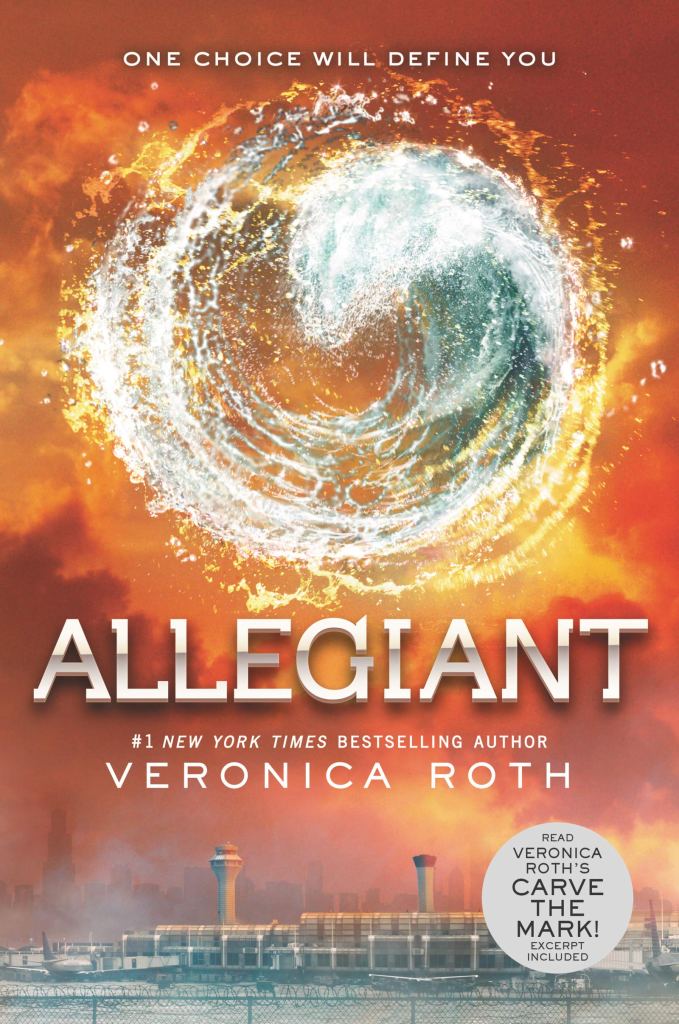
Allegiant book cover
Allegiant movie poster
In fourth grade, I finished the sumptuous feast that is the Divergent series, books that were so important to me in my childhood. Having been pleased years ago by the first movie adaption of the series, I had high, high hopes coming into the Allegiant movie…that you can already guess were not fulfilled.
[Warning: Reading ahead will reveal spoilers for the Divergent series]
If you’re familiar with the book and you’ve seen the movie, then you already know my largest grievance. Come on, say it with me out loud, and let’s relieve our agony together: orange!!
In the book, the world outside of Chicago is described as gloomy and dark, but in the movie, we get Kraft’s mac-and-cheese-flavored radioactivity!
I have no problem whatsoever with producers taking creative rights with the storyline—if the movie were the same as the book, no one would want to watch it, right?
Wrong.
Little plot meanderings and trimmings here and there will make a movie more enjoyable to sit through, but when it’s obvious that a three hour film won’t do justice to such a heavy book’s plot, then the movie project must be split into two. (Think Harry Potter and The Hunger Games.) Allegiant undoubtedly fell under this category, and I’m devastated that instead of making two films, the movie cut out half of the book’s plot, half of the characters, and hacked away at Veronica Roth’s masterpiece until it arrived at a sloppy post-apocalyptic world.
Uriah who? Cara who? So many members of the crew that accompanied Tris and Tobias out of Chicago weren’t present at all. Instead, the movie blew 90% of its precious duration on slow camera pans to show off “breath-taking”—but really, irrelevant—technology.
However, I did appreciate a few parts—that is, when I wasn’t being blinded by the orange. In spite of the twisted storyline in the movie, the script stayed true to the main characters’ identities. Tobias was Theo James (sorry but I can’t find any flaws with that.) Evelyn, his dictator mother, maintained her redemptive arc in the end, giving up power to be with her son. Peter, the “bad guy” who hangs out with the “good guys,” was sharp, sarcastic, and self-absorbed. My favorite line of the movie was “[t]hat’s why you pick a guy like me for a job like this,” intended for his boss to hear, which he delivers after shooting Evelyn in the knee when she turns back on their dark plan.
But, ok, I’ve reached my last complaint: Tris didn’t die in her quest to restore goodness in the world. This movie doesn’t deserve the name Allegiant if the ending doesn’t plunge its claws into your chest, wrench your heart out, and render you a sobbing shell of a human being for the next week.
Have you watched Allegiant? Share your thoughts in the comments! — Ritu B. ’24
For those who enjoyed this book, Ritu has recommended The Lunar Chronicles series for you to check out!
In an alternate 1800s France, six individuals must team up to pull off the heist of a lifetime. The thieves in question are a historian, an engineer, a performer, a gardener, and an old friend, all led by an angsty leader.
The setting is full of magic and wonder. Roshani Chokshi pulls from myths from all around the world to build a rich environment: There are references to the Bible, Greek mythology, Persian stories, and Indian deities. The words themselves are also full of magic: “History is a myth shaped by the tongues of conquerors.” Atmospheric settings and writing are not necessarily for all readers, but the lush story really worked for me.
While the plot did feel convenient at times, the success of the book came not from the events that occurred, but rather from the characters. Six characters is a lot of one book to flesh out, but this one managed to make all of them have compelling stories and character arcs. Severin, the group’s leader, struggles with wanting revenge for a lost inheritance and also wanting to protect the members of his team. Hypnos (the old friend) and Severin both struggle with being mixed-race in a society that sees whiteness as paramount. Enrique (the historian) sees parallels to his Filipino heritage and the Spanish colonization of his people. Zofia (the engineer) learns to understand how emotions work as she feels more at home with chemical reactions than with life forms. Tristan (the gardener) looks up to Severin, but is reluctant to go on any heists. And Laila (the performer), has a secret: She’s not a “normal” girl, and in the next few months, she will die.
This book has been heavily compared to Leigh Bardugo’s Six of Crows, and while the idea of having to steal something is the same, the execution is completely different. Six of Crows relies on a magic system that gives certain people (the grisha) special powers. The Gilded Wolves, however, uses logic and problem solving to complete the heist. What stood out to me is how the historian and the engineer work together to solve the puzzles. In an increasingly STEM vs humanities/social sciences world, having these two rely on each other to solve problems was so refreshing.
And if I haven’t convinced you to read this yet, the sequel The Silvered Serpents came out in late 2020, and the third book The Bronzed Beasts comes out in September 2021! —Review by Anika F. ’21
If you are looking for an emotional young adult story with paranormal elements, Cemetery Boys is the perfect book for you. Cemetery Boys follows a teenaged transgender male named Yadriel who is trying to prove his identity to his family. After a string of murders, Yadriel decides to summon a ghost with his brujo powers, but ends up summoning the wrong spirit.
The strong points of the book include (but are not limited to) the characters and the culture. When I initially read that the ghost summoned would be the “high school bad boy,” I was convinced that I would not like the character. However, as I read more and more, I found Julian’s personality to be so much more than the synopsis gives him credit for: He is loyal, brave, and accepting while also being funny and sarcastic. Similarly, I found Yadriel’s character to be a delight to follow. His journey with identity is so wonderfully done; you can see his struggles and successes as he proves to his family that he truly is a brujo. Latinx culture is also seamlessly mixed with the story. There are some beautiful scenes about Día de los Muertos, where Yadriel is able to communicate with his ancestors who have passed on. In particular, this book thrives when discussing the intersection of Yadriel’s gender identity and his cultural background.
My main complaint with this book has to do with the predictability of the plot. In essence, the story is a murder mystery where a few men end up dead. I guessed the murderer at around page 50 and was not surprised at all by the ending. My second plot critique does involve some spoilers, but to keep it vague: I like when decisions have consequences. Some of these characters seemed to make tough calls, but not face adequate repercussions.
Do I think these criticisms break the book? Absolutely not. Cemetery Boys is much deeper than the plot. Rather than being about a murder-mystery, this story is about love, identity, and family. And in those aspects, this book truly shines. –Review by Anika F. ’21
For those who enjoyed this book, Anika has recommended Felix Ever After for you to check out!
Some books you stay up reading till 3 A.M. because you love them and don’t want to put them down. For others, you’ve spent half the book yelling at the protagonist for being dumb, and (for the sake of your sanity) you need to know what happens next. Memoirs of a Teenage Amnesiac was the latter. Not that that’s a bad thing.
The book raises intriguing questions on identity: If you lost recollection of the last five years, how would you view your current lifestyle?
After falling down the stairs, Naomi loses all her memories from after the sixth grade. Enter an irresistible, rebellious boy who finds her. Throw in a jock boyfriend, parental divorce, a best friend loyal to the point of idiocy, and the ingredients seem very predictable (and perhaps slightly nauseating if you, like me, have consumed enormously more than the healthy amount of YA Fiction). Yet, we keep returning to this genre because we can’t get enough of the awkward, heartwarming teen romance—which you’ll find no dearth of here.
Ultimately, this book won’t change your life, but who even cares. Give it a shot if you want to drown your sorrows in some cliché YA! –Review by Ritu B. ’24
For those who enjoyed this book, Ritu has recommended Crazy Rich Asians for you to check out!

 Fourth Wing by Rebecca Yarros




 Harker US Book Blog