Some people never leave their hometowns, but Barbara Ehrenreich deliberately turns her life upside down. While most people imagine a vacation as a trip to an exotic or relaxing destination, Ehrenreich chooses the kind of “vacation” no one would want. For several months, she abandons her previous life and instead waits tables in Florida, cleans houses in Maine, and works retail in Minnesota. In her book, Ehrenreich sets out to explore the realities of poverty in America firsthand. She leaves behind her husband, her possessions, and her stability, arriving in unfamiliar cities with little more than a laptop, some cash, and three goals: to find a job, settle into a home, and make friends in a completely new city, all in an attempt to understand what daily survival looks like for millions of Americans. Throughout her journey, Ehrenreich records the stories of dozens and presents their struggles through an alternative perspective on American economic inequality. However, her undercover reporting ultimately feels limited in scope. While she mentions the struggles and traumatic stories of those she meets along the way—such as a teenage girl working for a cleaning company who survives on a single bag of chips each day—Ehrenreich rarely pursues these stories further. In documenting these conditions, she overlooks broader patterns and the systemic causes of these issues, glossing over experiences like those of trafficked dishwashers or middle-aged women working long hours at Wal-Mart. Overall, I felt that she provided only a brief glance at poverty in the United States. At times, the novel felt as though it justified workplace abuse that stripped her coworkers of their dignity and pride. Regardless, her insights allow readers to take away one central message: for those living in poverty in America, work is more than just a means of survival; instead, it becomes a process of slowly selling away their lives just to survive.
Rudolf Vrba, a Slovak Jewish teenager, becomes one of the first people to escape Auschwitz and reveal the atrocities – mass genocides and inhumane conditions – of the Holocaust to the world. With vivid detail and engaging writing, Sheinkin traces Rudolf’s transformation from a clever, rebellious youth into a relentless survivor. Along with his friend Alfred Wetzler, he risks everything in order to tell the world the truth about the continuous extermination of Jews in Nazi prison camps. The book plunges readers into the suffocating brutality of the Nazi regime, describing the daily horrors of Auschwitz, everything from the overcrowded barracks to forced dangerous labor to arbitrary executions. Alongside Rudolf’s tale runs the story of his schoolmate Gerta Sidonová, who had fled to Hungary with her family and was aiding with resistance against the Nazis.
I found Rudolf’s and Alfred’s escape fascinating, especially their ingenuity and courage while hiding for nearly four days inside a stack of wood, doused with tobacco and gasoline to ward off the SS’s dogs. Overall, one of the themes that really resonated with me was how heavy the cost is of bringing dark truths to light. -Review by Shamik K. ’27
The year is 2057. Humankind has occupied the solar system. The Rockhopper, a comet-mining spaceship staffed by the captain Bella Lind and her crew of engineers, medics, and explorers, is called upon for an important mission. One of Saturn’s moons, Janus, has mysteriously begun to travel out of the solar system at an accelerating speed; it seems to be a dormant piece of alien technology. Their mission is to catch up to Janus and learn its secrets, secrets which could bring humans immensely useful technology or even first contact with an alien species.
I personally loved this book for its very unique, creative ideas; plausibility (making it a part of the awesome hard sci-fi category); and pure thrill. While Reynolds has outlandish ideas, he approaches them with hard facts and plausible science, not taking magical shortcuts until some of the inexplicably complicated alien technology the crew encounters. The narrative follows a sense of practicality in the way the crew approach the situation they are thrown into. Moreover, much of the plot involves interpersonal conflicts that are quite developed over the course of the characters’ unusual mission. Perhaps I tend to focus on the sci-fi, adventuring aspects of the novel, but I feel like Reynolds bungles the character dramas a bit; for example, the conflicts between Captain Lind and one of her subordinates seemed a bit overdone. -Review by Shamik ‘K. ’27
At first glance, Yellowface by R.F. Kuang is a book that prides itself on its timely realism. Chock-full of references to Twitter, Youtube, Goodreads, among other popular websites, Kuang takes a risk by placing her book in a very specific era that modern audiences are all too familiar with. The biggest risk in potential with this is that it can age your book significantly, and even worse with the inclusion of modern references, it can result in a book that appears to be trying far too hard to be relevant. Even though Yellowface came out in 2023, a mere two years ago, I personally found that the language and references didn’t add to the reading experience. Perhaps it was my lack of experience in reading books so explicitly modern, but constant references to the “Twitterati” and being cancelled were more tiresome than humorous. To be fair to Kuang, it is very clear that Yellowface was designed to be a popular, biting satire. I was unsurprised to learn that it boomed in popularity due to BookTok because the satire is engaging and easy to get involved with, resulting in a book with mass appeal. Yellowface follows June Hayward, who adopts the alias Juniper Song in order to publish and take credit for the unpublished manuscript of her deceased acquaintance, Athena Liu. Yellowface also puts us in the first-person perspective of June, whose narration is at times nuanced and interesting, and at times so blatantly racist that I question if satire is a little generous. Portraying a protagonist who consistently subjects others to microaggressions is an interesting choice, but it doesn’t make it easier as a reader to stay in the perspective of someone who says she “tries not to gag” in the presence of Chinese food. Yellowface has a lot of redeeming qualities, with a wonderful premise that serves as an engaging source of conflict throughout. June gives a lot of commentary about authenticity and privilege within the industry, constantly defending her theft by saying that Athena would steal from other people for her novels as well. These moments, where Kuang dives into the nuance of the situation and portrays her protagonist in a human light are the best ones. They give an opportunity to look beneath the theft and see the person underneath. Unfortunately, the execution fumbles as the book continues, eventually concluding with an ending that can only be described as a trip over the finish line. Kuang spends time building up a conclusion that would provide a satisfying ending, making June face justice while also giving her closure for her actions, only to completely abandon it and pivot into an ending that feels shockingly fantastical for a relatively grounded story. The needless introduction of a cartoonish villain completely grinds the book’s pace to a halt, and when that happens with one chapter to go, there’s very few paths to recovery from there. The ending is the part that has stuck with me the longest after reading, but unfortunately because of how completely unnecessary and jarring of a turn it was. I found myself wishing that we could have seen the path Kuang spent multiple chapters building to instead, which would have been much more fulfilling and clean. Overall, Yellowface is a very interesting book. It opens the door to topics like authenticity, diversity, and the publishing industry, but fails to go any further than a surface level peek. As a satire, it does the bare minimum, but is at times mind-numbingly obvious. While it doesn’t have my recommendation, I can’t say I don’t think it was worth reading, because the chaotic end and few moments of nuance were enough to make me think it had something to say, even though those things might not have been the best executed.
The Chosen and the Beautiful is a retelling of The Great Gatsby from Jordan’s perspective with some fantasy elements. I loved this book! It’s explicitly in conversation with the themes and motifs of the original, rather than being its own story or trying to be quirky and twist things up— it takes Fitzgerald’s throwaway references to the dynamics of race, class and sexuality and makes those undertones explicit. The prose is gorgeous and well-paced. I often found myself rereading sentences and paragraphs just to bask in the beauty of Vo’s language. I finished this in two days, even though I knew how the story ended, or perhaps because I did. It was very refreshing to have a light read after several months in the APUSH textbook trenches.
The magic system is based off of cultural superstition/myths—I would’ve liked to see Black and Native American tradition dealt with beyond a few offhand references, especially considering how Vo relates them to Gatsby, but I also get that the author may not have felt that it was her story to tell. Regardless, the omission is a bit awkward in a story meant to fill these sorts of omissions in the original. Fitzgerald already does an excellent job of writing Daisy, but seeing her flaws through the lens of a close friend makes the banality of her cruelty feel more real. I really DO know people like that—people who can be carelessly kind and good without changing their fundamental nature, who are self-centered without being genuinely evil.
The Chosen and the Beautiful doesn’t really stand on its own; to me, that’s more of a feature than a bug, but I understand the complaint. Vo is adapting and staying faithful to a plot centered around Jay Gatsby in a book that is not about Jay Gatsby—Jordan doesn’t always meaningfully engage with the central events of the book, which can get a little awkward. Vo does a good job of filling in the gaps with Jordan’s own introspection and Jordan’s own character arc, but the story of Jordan Baker and the story of Jay Gatsby sometimes tug against each other. My biggest qualm is the ending—it doesn’t really measure up to the sense of catharsis and full-circle completion of the original. It’s not satisfying in the same way. And the magic system has some utterly insane implications that aren’t really dealt with, but perhaps the forthcoming companion/sequel will fill those gaps.
I heavily recommend reading this book during or after you read Gatsby in English 3. It will make the original feel fresh and interesting if you’re getting bored of the same characters and themes, and you’ll enjoy the essay-writing and discussion process more in class, which will probably result in (gasp!) a better English grade. 3.5 stars, rounded up.
Spoiler warning: no major spoilers, but a lot of minor ones. This also won’t make any sense unless you’ve actually read the book.
I reread this book two years after it dropped in hopes that I had hallucinated it having been bad (I only remembered one plot point. I’ll give you a hint: it was glowing.) I was sorely disappointed.
Many elements of the book were a let-down, and it’ll be difficult for me to articulate why. I think the most pressing issue is that Hell Bent tries to pack too much plot into too short of a book and leaves character development by the wayside.
The central mystery of Ninth House is not who killed Tara Hutchins; it’s who Alex Stern is, and by extension who Darlington is, who Hellie and Len are, where did they go, why do we care. These are the questions the reader is trying to answer as they work their way through the book.
But Hell Bent just focuses on its moving parts—Eitan, Anselm, Reiter, Michelle, Walsh-Whitley, Darlington himself. In a Goodreads Q&A, Leigh Bardugo mentioned that the Alex Stern series was originally going to be, like, 12 books, then got shortened to 5, then 3, because they took so long to research… and unfortunately, that’s very apparent. Hell Bent felt like it was the premise of several different books frankensteined together.
Several books’ worth of character development gets awkwardly skipped over. Mercy, Tripp and Turner get awkwardly shoehorned into the main cast, with their character arcs hastily jammed in in the form of supercuts and flashbacks. I say this not because I think they shouldn’t be, but because I think they should’ve been given more screentime and development—each of them deserved their own book in the spotlight.
Tripp was particularly jarring; in the original book, he’s a hapless symbol of white privilege and the infinite second chances given to wealthy young boys. There’s hints of where Bardugo wants to go with his character—the minor reveal that he was instinctively aware of what Blake Keely was came all the way back in book 1—but the transition from set dressing to guy we are supposed to care about just isn’t actually executed. Mercy’s being brought into the fold is also clumsily done. She’s one of my favorite characters, but I think the revelations she has in Hell Bent can’t be contained within the span of a few conversations.
People complained about the pacing of Ninth House, but Ninth House was good because you watched things unravel slowly; Hell Bent sacrifices all of that and thus has the opposite problem (although it wasn’t a problem in the first place). Too much plot is crammed in. Nobody stops to take a breather and emotionally process what’s going on. Ninth House was self-aware in a way that Hell Bent is not.
And I really, truly hate to say this—because this series is not about Darlington, he is not the hero of this story, and that is part of the point. I’ve seen people act like the white man was the best part of the series and it drives me utterly insane—but he really should’ve had more screentime. I would’ve wanted to see his POV earlier. Hell Bent is, ostensibly, about rescuing him. The fun of Ninth House was piecing the story together from the split POVs; perhaps Hell Bent could’ve pulled a similar trick with Alex’s thoughts from above, and Darlington’s thoughts from below. I support him going off the rails, but I want to see that process occurring bit by bit, not just a jump-cut to him suddenly being naked and feral with claws and horns. Darlington’s entire premise is that he’s a gentleman—if he’s not acting the part, we need more than a few sentences on why.
The story read like one of my English essays: a haphazardly jammed-together collection of plot notes, impossible to treat with their proper gravitas. Any legitimately compelling moment fell flat, because there was no real buildup, just payoff, payoff, payoff, except for the payoff didn’t feel like payoff because there was no buildup to make it a payoff, and we didn’t even get the biggest payoff of the series that everybody was hoping for (IYKYK). Alas.
I don’t care if book 3 takes another four years (I actually do, but that’s beside the point)—just please let it make up for this.
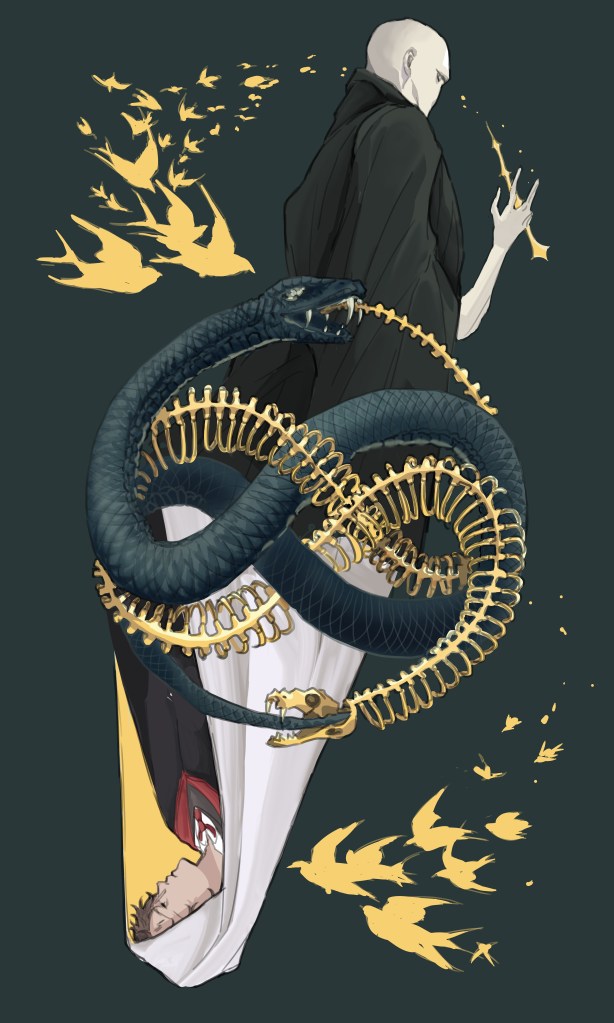
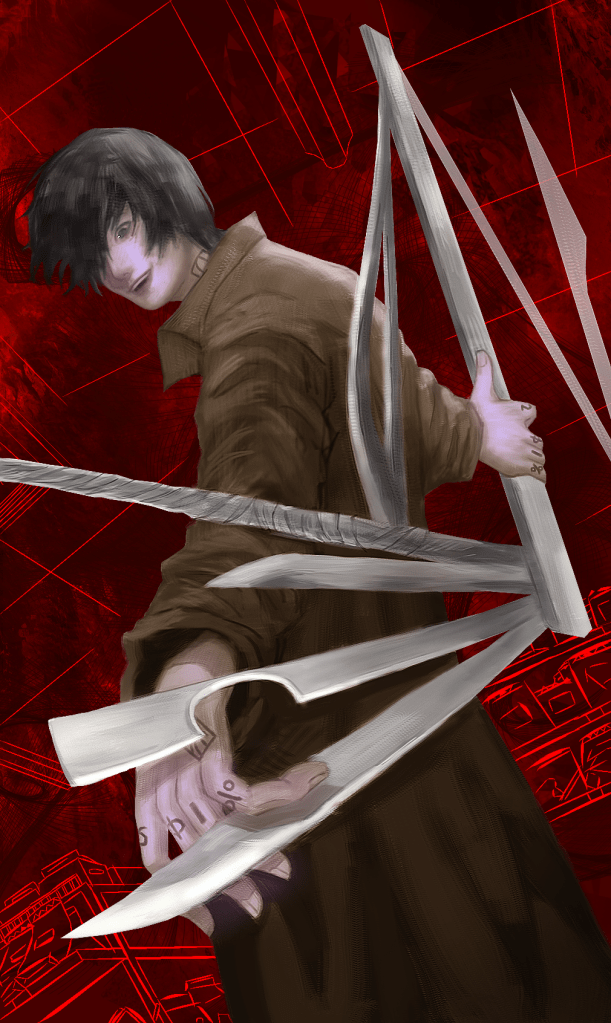
Much like the Fanfiction Contest, we were thoroughly surprised by both the quantity and quality of submissions this year. At risk of sounding like a college rejection letter, the decision process was, indeed, very difficult—but ultimately, the thing that distinguished this piece above all others was that not only did it accurately and affectionately depict its source material, it invited deeper thought about it. The balanced composition is both visually appealing and meaningful to the source material, and the use of symbolism—the ouroboros, the golden birds, the living and dead snakes, and the various infinity symbols subtly woven into the work—universally impressed judges. It’s clear that the artist put a lot of love into this piece (and its source material).
Second place
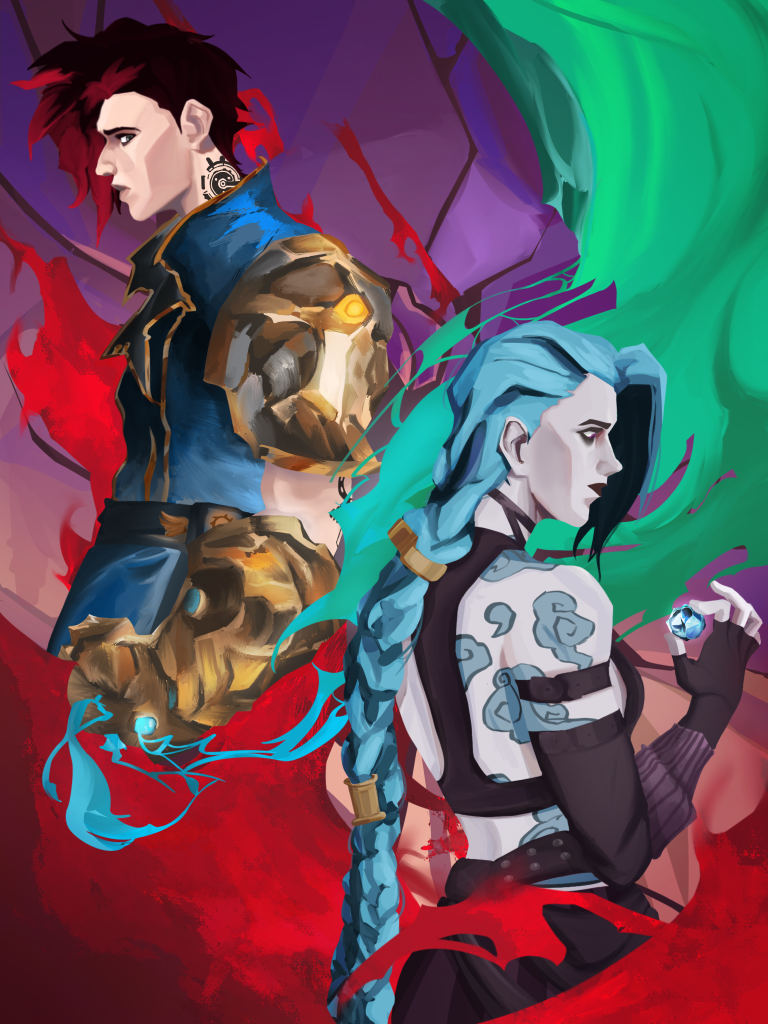
Fracture Point by Abigail L. ‘28 (Fandom: Arcane)
This piece was immediately singled out during judging as a standout, and everyone agreed near-instantly that this work deserved an award. The composition of the piece is dynamic and fluid, cleverly incorporating the details of the characters’ designs. The painting style replicates the iconic look of the original show, but is still distinctive as the artist’s own style—we especially loved the rendering of the metal shoulder plate and glove, and the blue fire. The artist successfully and subtly captured the complex emotions of the two characters in their facial expressions, their body language, and even the direction of their gaze.
Third place
Untitled by Rumi (Fandom: Batman)
This was the first piece we saw upon opening up our submissions, and it left a lasting impression. The artist’s mastery of form, lighting and color is apparent—we especially loved the sharp, Leyendecker-esque rendering of the masked Batman portrait, and the detailed, evocative lighting of the top-left portrait. One anonymous judge praised the piece’s “excellent knowledge of anatomy.” The deep, moody color palette accurately reflects the tone of the source material. The artist’s deep love for Batman is apparent. We could not, in good conscience, not give this piece an award.
Honorable mentions
In addition to our top three pieces, we also wanted to shout-out several honorable mentions that impressed our judges:
“One for sorrow two for joy” by bread herring (Fandom: Passing)
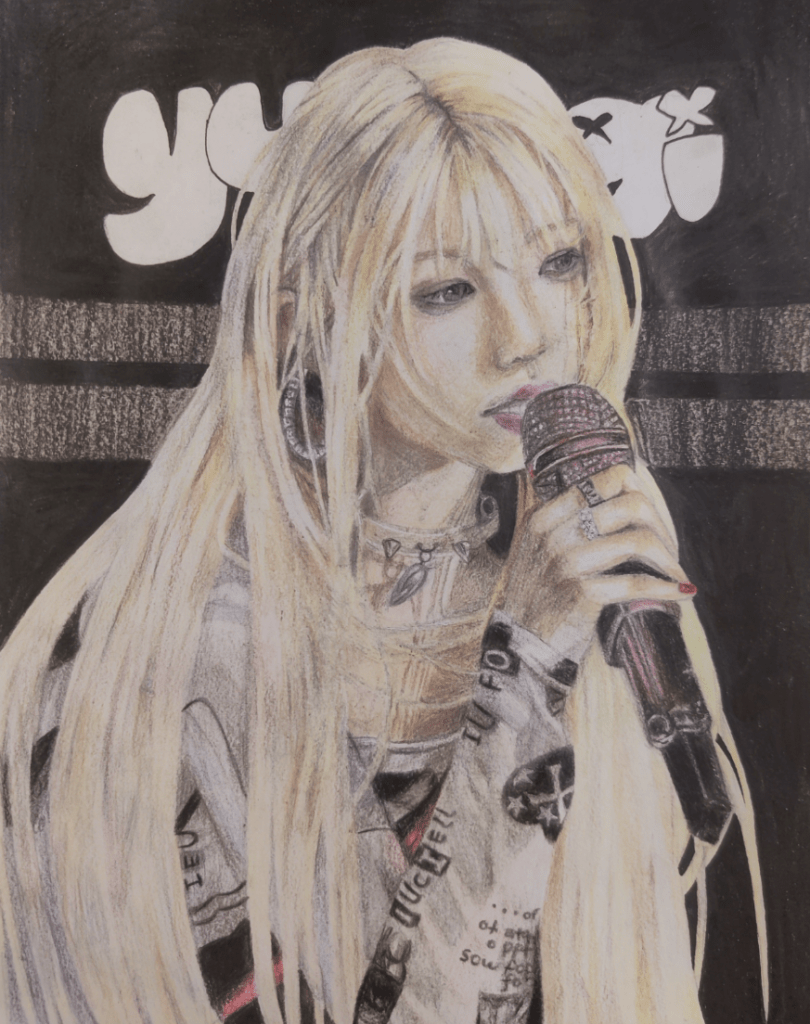
“Yuqi” by Cabbage (Fandom: G-idle)
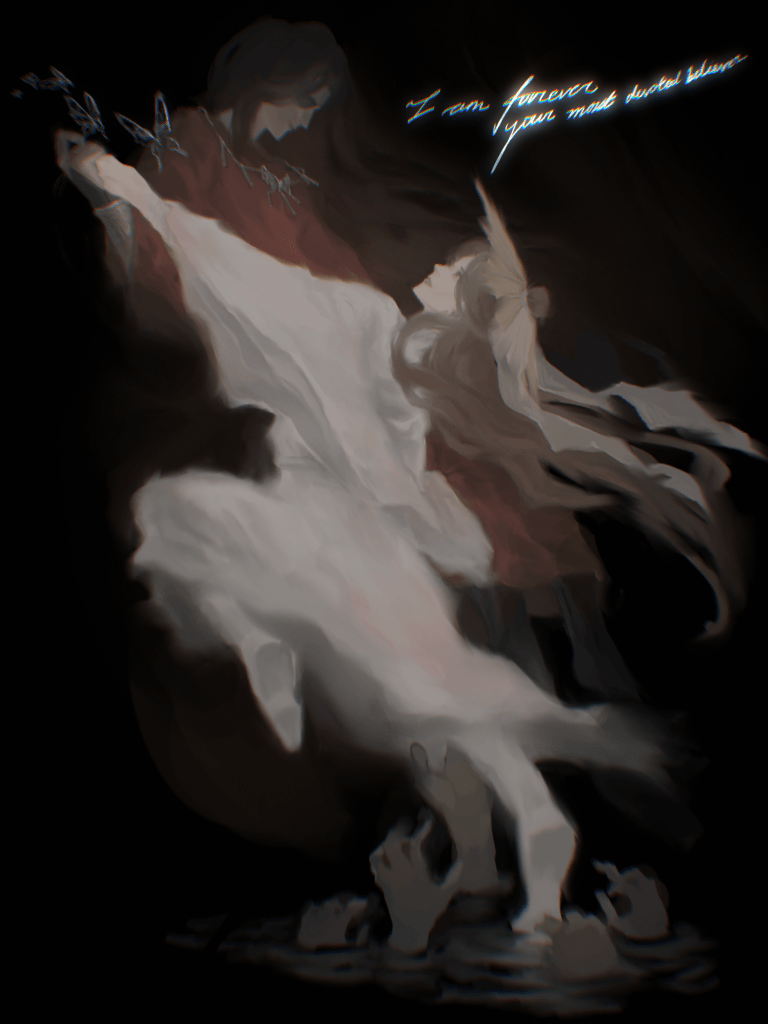
“I am forever your most devoted believer” by zaoshanghao (Fandom: Heaven Official’s Blessing (Tian Guan Ci Fu)
We had such amazing submissions this year, it wouldn’t be fair to withhold all of them from you… Please enjoy them below:
“The Dream of the Red Chamber is a peculiar novel to write a review for. I’ve been reading it on-and-off over the course of the last three months, and I’ve had to reread my favorite sections to really collect my thoughts. In reflecting, I’ve come to the conclusion that the novel is pretty worthwhile.
For the uninitiated, The Dream of the Red Chamber is an 18th-century Qing Chinese novel, among the Four Great Classical Novels of Chinese literature. In the frame narrative, a humble primordial stone begs a Buddhist monk and a Taoist priest to help him experience the pleasures of the mortal “red dust.” The stone is thus incarnated as the pampered heir Jia Baoyu, who cultivates a doomed love for his cousin Lin Daiyu in the pleasurable Daguanyuan garden and navigates the declining fortunes of four aristocratic families. Due to my limited knowledge of Chinese, I elected to read Chi-chen Wang’s translation using the Wade-Giles romanization (I will refer to the characters in pinyin). Although Wang ultimately abridged the 120-chapter novel into 40 chapters and removed much of the poetry and nuance introduced by Cao, I found his adaptation to be suitable for a first read-through where those details would have been inevitably glossed over anyways.
The story reads in an almost episodic fashion, with various courtly vignettes informing an overall metanarrative of societal decline. Due to this structure, most of the characters in this novel are static, and as the novel progressed, quickly made themselves unlikeable to me, either through their actions or ignorance. Baoyu, our protagonist, was a prime example. His petulance, passivity, lust, and hedonism deeply frustrated me as the troubles of his family became clearer. In fact, at times he literally sits and stares catatonic as events unfold around him. Don’t mistake this for a negative, though — his inability to take responsibility enhanced for me the message that all pleasure regresses into dust, and a certain turning point in the middle of the book made me feel really sorry for him. The only characters I could truly root for were the truly innocent who underwent horrible psychological and physical abuse at the hands of others, usually female servants victimized by either Baoyu’s ignorance or the Macchiavellian antiheroine Wang Xifeng.
My main criticism is with the pacing. Perhaps it is a consequence of Wang’s effort to compress 120 chapters into 40, but I found myself incredibly confused as to who was who. It took me a solid few minutes with a family tree online to truly understand the complex relationships between the four families. I’d sometimes start reading a chapter and give up halfway through because I didn’t know who any of the characters were, which really hurt the episodic nature of the text and made it harder to connect with the characters. It wasn’t a huge issue, though. In my opinion, all that means is that this text will take extra effort to digest.
I want to end this review by talking about the ending (in a spoiler-free way). The thing is, it completely contradicts everything that’s been established about the characters, and subverts the overarching narrative Cao was building up. Yet it contained some of the most beautiful literature I had the pleasure of reading in the book. Puzzled, I sleuthed online and learned quickly that the last 40 chapters of the original 120 had been written by an unknown author with completely different intentions from Cao. In other words, for the last third of the book, I too was a captive of the “red dust,” too blinded by the feel-good writing to question its authenticity. Yet I maintain that the ending is beautiful, and I think its dubious authorship enhances its value. Is Baoyu’s happy conclusion illusory by necessity? This is a question I hope to revisit upon future examinations of this text later in life. The truth is that we will never know, and accepting that fact is our first step to abjuring the red dust.”
Can you believe this is the FOURTH ANNUAL contest?!?! In that time we have gotten some amazing submissions, and this year was no exception. We loved reading all the contest entries. Judging them, however, was very difficult! After intense deliberations, we arrived at our winners and three honorable mentions. Check them out below.
Judges comments, “Creative, passionate, and stylistically resounding”
Author’s description of the original work:“Gattaca is a sci-fi film about a future society driven by eugenics where children are conceived through genetic selection to ensure they possess the best hereditary traits of their parents. The film centers on Vincent Freeman, a man who was conceived outside the eugenics program and struggles to overcome genetic discrimination to realize his dream of going into space. Vincent assumes the identity of Jerome Eugene Morrow, an artificially-conceived man with near-perfect genetics, in order to make his way up the ranks.”
Authors description of their fanfiction:“What if perfection was determined by musical ability instead of genetics? A look into an alternate modern universe where young Jerome Morrow is a prodigious violinist, this fanfiction details how he grapples with the weight of familial expectations, relentless self-discipline, and his burning desire to be recognized for his own artistry beyond labels of perfection or legacy.”
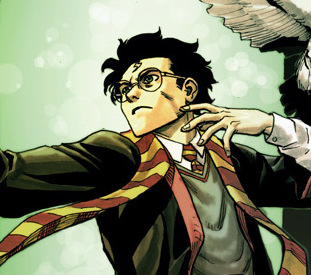
”Harry James Potter” (cropped) by Reilly Brown on Wikimedia Commons
Judges comments, “Brought back childhood memories of the first time one of us read Harry Potter”
Author’s description of the original work:“Boy learns that he is part of a magical world and that he needs to defeat big bad evil overlord. Boy proceeds to do just that, and everybody loves him basically.”
Authors description of the their fanfiction:“UHHH so said boy grew older and got mad at the world so he did what any reasonable person would do and goes to a painting of his dead, very senile mentor and asks for advice. Neat little time travel deus ex machina occurs, so he gets sent back to a few decades prior and meets with younger, slightly less evil big bad overlord. I only wrote the first four chapters out of 22 but I have the plot for the entire story written out. I did not include it because my outline notes are slightly rambling.”
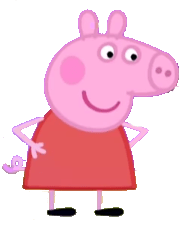
Judges comments, “The beginning of what will surely be a most intriguing story!“
Author’s description of the original work:“Roblox Piggy is the story of an alternate world of Peppa pig where a zombie virus is affecting everyone— specifically, this story-based game exploded and became the #1 played game on Roblox (12 billion+ visits), but no one has ever written anything about it: surrounding the mysteries, and lore.”
Author’s description of their fanfiction: “My fanfiction transforms Chapter 1, “The House,” from the game into a detailed, immersive written narrative. Its the POV of a police officer investigating the Piggy residence, where he encounters Penny (aka Peppa), who has turned into a zombie. I reimagine a player’s experience, capturing the tension, puzzles, and escape mechanics of the game. I try to word-ize the atmosphere and bring it to life, which can help us players connect more deeply to the game (and reminisce about all the fun we had trying to figure our the lore!). Definitely going to continue till Chapter 12 and the next 12 Chapters in Book 2 and convert all of those into actual chapters and books!”
Honorable Mentions
Honorable Mention for Outstanding Achievement in Absurdity
Fandom: “How Corruption Destroys Armies – Theft, Graft, and Russian failure in Ukraine” – Video by Youtuber and former defense analyst Perun on Youtube
“The Meursault Investigation takes place in the same world as Albert Camus’s The Stranger, and tells those events from the perspective of the younger brother of the unnamed Arab murdered by Meursault, who published The Stranger upon his release from prison. In its frame story, the reader takes the role of a voiceless college student who interviews Harun, the brother of Meursault’s “unnamed Arab.” The novel gives the “unnamed Arab” his name — Musa — and provides a unique anticolonial Algerian viewpoint on the philosophical side of Camus’s work through the jaded, unreliable narrator’s picaresque experiences as a fence-sitter during the Algerian Revolution.
The Meursault Investigation is a novel I enjoyed much more in concept than execution. My main issue with it was that its attempts to juxtapose Meursault and Harun were too heavy-handed, with Harun’s narrative having blatant parallels to nearly every major scene in Camus’s novel (with varying levels of success). This became especially noticeable pacing-wise in the second half of the book, into which most of Harun’s plot is crammed; I nearly rolled my eyes when I realized that Meriem, Harun’s love interest, was meant to be a foil to Marie Cardona. It was almost too obvious.
Despite this gripe, the book held my attention throughout its relatively short 191 page duration. Two interesting insights into The Stranger struck me in particular: first, regarding the absurdity of ‘just’ violence and the ethics of liberatory war in Harun’s interrogation; and second, a passage in which Harun praises The Stranger despite his hatred of Meursault because its economy of language allowed it to convey the last words of a person close to death. I also greatly enjoyed the attention devoted to Harun and Musa’s mother, who was a deeply complex character and a highlight in a way her counterpart in The Stranger was not.
If you haven’t read it already, I recommend considering this book after you’ve read The Stranger (perhaps in your first semester of AP Literature), just because it’s refreshing to read such a different take on it. Though it has problems, it’s a thought-provoking supplement that relevantly excoriates the blind spots of Camus’s contribution to the Western canon.”

 Nickel and Dimed: On (Not) Getting By in America by Barbara Ehrenreich

















 Harker US Book Blog