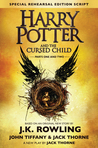
Harry Potter and the Cursed Child by J.K. Rowling (review by Anika B. ’18)

Harry Potter and the Cursed ChildHarry Potter and the Cursed Child by J.K. Rowling
My rating: 5 of 5 stars

By the operationalization of the star rating system, five stars means Harry Potter. Although this book, or play rather, was faced with high expectations, it was everything I hoped it to be and more. This story takes place 19 years after the Battle of Hogwarts, and it follows the adventures of Harry and Ginny’s son, Albus, and Draco Malfoy’s son Scorpius. Plagued by troubled relationships with their respective fathers, Albus and Scorpius use a stolen time turner to prevent the death of Cedric Diggory, leading to huge complications.

Due to its structure as a play, the book lacked J.K. Rowling’s signature descriptions, but the dialogue was very smooth and well written. The plot was brilliantly delivered, and there was never a dull moment. The new characters were well developed and the dynamic relationships held the perfect degree of depth. Finally, by taking readers back in time, the book referred to moments from the earlier Harry Potter books in ways that would have made any Potter fan feel nostalgic.

Once I picked up the book, I could not put it down. Although Harry Potter and the Cursed Child was not a traditional Harry Potter book, it did not disappoint.

View all my reviews

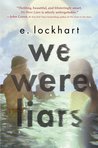
We Were Liars by E. Lockhart (review by Anika B. ’18)

We Were LiarsWe Were Liars by E. Lockhart
My rating: 2 of 5 stars

E. Lockhart’s We Were Liars follows a member of the distinguished Sinclair family, Cadence Sinclair Eastman, who is recovering from a brain injury she received in an accident that she cannot remember. As she recalls more about the accident, she begins to question her family’s ideals and develops her own identity. For me, the strongest element of this novel was the addition of various stories about a king and his three daughters being told in parallel to the main plotline. These short stories created an interesting structure and served as perfect transitions between sections. However, besides the protagonist, most characters were very black-and-white, and lacked the dynamic personalities needed for an effective story. Cadence remembers the majority of the details involving her accident quite suddenly towards the end of the book. Spreading out the realizations and starting them earlier in the book might have resulted in a stronger, more engaging novel. Most fans of this book believe the ending to be stunning, but I found it incredibly disappointing, as it seemed to contradict much of what had occurred earlier. Overall, the book had an impressive structure, but the one-dimensional characters and ending diminished its overall efficacy.

View all my reviews

Why We Broke Up by Daniel Handler (review by Megan H. ’18)

Why We Broke UpWhy We Broke Up by Daniel Handler
My rating: 4 of 5 stars

Why We Broke Up by Daniel Handler (more commonly known under his alias Lemony Snicket) tells the story of the short-lived romance of Min Green, indie film fanatic and nameless nobody at school, and Ed Slatterton, the popular co-captain of the basketball team. The novel follows Min, as she returns mementos from their relationship back to Ed after their breakup, each accompanied by a letter addressing him, which divulges to the reader the story behind the souvenir, as well as a reason that the two broke up, as stated in the title. The backstory behind each trinket composes the entire tale of the relationship, from start to finish, while the letters from Min to Ed reflect her opinions and emotions she feels as she goes through it. Handler excellently depicts the classic teenage relationship, while weaving in his own twists that have always characterized his distinctive writing. Although the events that the two protagonists face are incredibly interesting and unlike a typical romance novel, their personalities sometimes fall flat and seem stereotypical, as Min is depicted as an artsy hipster while Ed is portrayed as the classic jock. However, I still enjoyed this book from the beginning to the end and would recommend it to anyone looking to read a unique story about the life and death of a relationship.

View all my reviews

Fortune Smiles by Adam Johnson (review by Andrew R. ’17)

Fortune SmilesFortune Smiles by Adam Johnson
My rating: 4 of 5 stars

In Fortune Smiles, which won the most recent National Book Award, Adam Johnson collects six short stories that showcase both his penchant for dark, uncomfortable subject matter and his startlingly powerful ability to treat unsympathetic characters with compassion. Johnson, who has garnered laurels in the past for a novel about North Korea, repeatedly takes on apparently unredeemable perspectives—a virtual-reality-obsessed programmer in Palo Alto, a reclusive pedophile with a traumatic past, a retired and unrepentant East German prison warden—and convinces the reader to replace at least some disgust with sympathy. Certain stories, like “Interesting Facts” (about a raging cancer sufferer) and “Hurricanes Anonymous” (about a displaced delivery man in Louisiana in 2005), miss the magic ratio of darkness to compassion and spoil the effect. But then you get a piece like “Fortune Smiles,” in which Johnson turns his focus back toward North Korea to explore the lives of two defectors to South Korea and their near-suicidal impulse to re-defect back into the North. This story closes the collection, cementing the book’s diverse but complimentary themes: the irrationality of obsession, the persistence of pain, and, most importantly, the essential humanness of everyone, even those we don’t understand.

View all my reviews

Lark & Termite by Jayne Anne Phillips (review by Andrew R. ’17)

Lark & TermiteLark & Termite by Jayne Anne Phillips
My rating: 5 of 5 stars

Very occasionally, a book you’ve never heard of and wouldn’t expect to like by an author you don’t know will make its way into your hands and remind you why you read books in the first place. For me, Lark and Termite was that book. Jayne Anne Phillips’s subtle, looping novel combines the story of Leavitt, an American soldier mortally wounded by friendly fire deep in enemy territory during the Korean War, with that of his orphaned son Termite, a sufferer of severe mental and physical disabilities nurtured by his half-sister Lark and the few sympathetic members of their small-town community. Flitting through the book, seen only from a distance, is Lola, the biological mother of both Lark and Termite, whose abandonment of her two children and of the town of her birth casts a long, complicated shadow through the characters’ lives. Once the stage is set and the characters introduced, the novel’s plot is simple and unadorned. Viewed through the questioning gaze of Lark and the lyrical, kaleidoscopic perspective of Termite, though, even the simplest childhood memory takes on beautiful, subtle shades of meaning. There aren’t many books that I plan to read and reread and reread, but this is one of them.

View all my reviews

The Great Transformation by Karen Armstrong (review by Andrew R. ’17)

The Great Transformation: The Beginning of Our Religious TraditionsThe Great Transformation: The Beginning of Our Religious Traditions by Karen Armstrong
My rating: 2 of 5 stars

In The Great Transformation, religious historian Karen Armstrong sets out to analyze the origins of Buddhism, Judaism, Confucianism, and Daoism in the context of political and social strife in the centuries leading up to the Common Era. As a primer to the study of ancient Mediterranean and East Asian philosophy, The Great Transformation occasionally hits the mark: its analyses of the historical realities of the Babylonian Captivity in the Middle East and the Period of the Warring States in China bring clarity to historical periods often overshadowed by the state-building that occurred on either side. Such moments of lucidity, however, appear far too rarely in this thick 500-page text. Having set out to compress an eight-hundred-year history of philosophical movements in the entire Eastern Hemisphere into a single volume, Armstrong falls almost constantly into disjointed, abstract accounts of wars, reigns, and migrations, indulging in so many disparate stories that her ostensible subject—commonalities of Mediterranean and Asian religious movements—disappears for twenty pages or more. Too wide-ranging to shed light on any particular historical subject and too bogged down in specifics to synthesize its parts into one coherent thesis, Armstrong’s book leaves the reader with little more than a mound of undigested historical facts by the last page.

View all my reviews

The Samurai’s Garden by Gail Tsukiyama (review by Catherine H. ’17)

The Samurai's GardenThe Samurai’s Garden by Gail Tsukiyama
My rating: 5 of 5 stars

Gail Tsukiyama’s The Samurai’s Garden tells the tale of a young Chinese man, Stephen, who travels to a sea-side town in Japan to recover from tuberculosis during the Second Sino-Japanese war in the late 1930s. He stays with Matsu, who has worked for Stephen’s family all his life, and learns to live in the quiet town of Tarumi while he regains his strength. Stephen also meets Matsu’s friend Sachi, also an outcast, and slowly gains her trust. This book tells a touching story about friendship in a time of war and Tsukiyama’s simple, yet elegant language really draws the reader into Stephen’s story. I really appreciated learning about the war and how Tsukiyama incorporated Stephen’s identity as a Chinese man who is immersed in Japanese culture and makes friends at Tarumi during this time period. I would recommend this book to anyone looking for a satisfying read.

View all my reviews

The Bean Trees by Barbara Kingsolver (review by Andrew R. ’17)

The Bean Trees (Greer Family, #1)The Bean Trees by Barbara Kingsolver
My rating: 4 of 5 stars

Initially, Barbara Kingsolver’s debut novel is appealing but unremarkable: a native Kentuckian on the cusp of adulthood named Taylor Greer hits the road, hoping to escape the stifling small-town life that’s suffocated her for her entire life. As Taylor’s odyssey through the Southwest progresses, though, a warm, eccentric cast of characters emerges that begins to set the novel. Chief among these is Turtle, a Native American toddler unceremoniously dumped in Taylor’s truck while her back is turned, who quickly becomes the heart of this endearing, mostly light story. For me, the book’s appeal was rooted in its lively sense of humor: characters like Mattie, the owner of a middle-of-nowhere auto repair shop called “Jesus Is Lord Used Tires,” kept me engaged even when the plot got bogged down in sentimentality. Despite the lofty themes of motherhood and self-actualization that float through the narrative, The Bean Trees, at its heart, isn’t much more than a tale about a girl who leaves her small town to see the big wide world. That’s a story we’ve read before, of course, but Kingsolver’s talent for character and humor makes it worth reading again.

View all my reviews

Lock In by John Scalzi (review by Catherine H. ’17)

Lock In (Lock In, #1)Lock In by John Scalzi
My rating: 4 of 5 stars

John Scalzi’s Lock In introduces the reader to a world in the near future where millions of people have been affected by a virus that immobilizes the body but leaves the brain fully functional, while others have had their brains altered but still have fully functional bodies. Those who are immobilized are “locked in” and can use “threeps,” or robotic bodies, to interact with others in the physical world; those who have had their brain chemistry changed but have had no other physical effects are called Integrators and can allow those who have been “locked in” to borrow their bodies for a time. Hadens, those who have lost the ability to use their bodies due to this virus, find themselves in a new community that can exist outside of the physical realm, because they are not attached to their bodies. Scalzi does some interesting world-building and purposefully leaves the protagonist, Chris Shane, ambiguous. For example, Chris’s gender and race are hardly mentioned, which leaves the reader to interpret how Chris interacts with the world as an FBI agent looking to solve a murder that may have involved Hadens. I appreciated Scalzi’s subtle inclusion of diversity in the novel, and I look forward to reading more from him.

View all my reviews

Out of the Easy by Ruta Sepetys (review by Melissa K. ’18)

Out of the EasyOut of the Easy by Ruta Sepetys
My rating: 5 of 5 stars

Out of the Easy begins with seventeen-year-old Josie Moraine’s stark opening line: “My mother’s a prostitute.” From the very first sentence, author Ruta Sepetys sucks the reader into the world of 1950s New Orleans, a place rife with scandal and mystique. Desperate to escape the stigma of her mother’s reputation, Josie dreams of leaving New Orleans by attending college far from the South.

Everyone in the novel has something to conceal—the wealthy Mr. Lockwell hides his trips to the French Quarter from his wife; Josie’s friend Patrick hides his aging father’s memory loss from the authorities; Josie hides a pistol under her skirt. The inexplicable death of a wealthy Memphis businessman in the French Quarter only adds to Josie’s list of secrets, especially when she suspects her mother’s involvement.

Ruta Sepetys writes flawlessly, revealing striking historical details through Josie’s observant eye. As historical fiction, Out of the Easy is painstakingly researched and powerfully told. Do I need to say more?

View all my reviews