Tag Archives: Psychology

The Wings By Yi Sang (Review By Jason S. ’25)

The WingsThe Wings by Yi Sang
My rating: 5 of 5 stars

Want to see a Korean take on bite-sized psychologically gripping novellas like The Stranger and The Metamorphosis? Look no further than The Wings, by the early 20th century modernist Yi Sang.

These comparisons are of course not made to suggest that Yi is derivative in any way. Rather, it is a testament to the sheer amount of pain and alienation Yi can convey in as little as 40 pages. The story follows an unnamed 26 year-old narrator who is completely ignorant of human society. Manipulated by his wife Yeonsim, he languishes in the darkness of his room and accepts the vast inequality between his and Yeonsim’s lifestyle. Nevertheless, he wonders what her occupation is, and his attempt to learn more about her and humanity has tragic consequences.

While reading through the novella, I was struck by the childlike naïveté with which our narrator approaches the world. For instance, he concludes from his observations that the reason people exchange coins is that there is some pleasure inherent to bartering, and becomes immensely happy just from giving Yeonsim some coins. This simplicity makes his eventual loss of innocence even more crushing as we attempt to piece together Yeonsim’s circumstances.

I also found it incredibly interesting to read The Wings in the context of Yi’s life. Without giving too much away, The Wings is a semi-autobiographical piece of literature and mirrors Yi’s own relationship with his wife, who had an occupation he was deeply ashamed of. In addition, Yeonsim’s treatment of the narrator parallels the colonial Japanese oppression of the Korean identity, and Yeonsim’s occupation ends up being incredibly relevant to Japanese abuses of power during Yi’s lifetime.

The Wings manages to pack raw emotion and several layers of analysis into 40 pages. It’s no wonder many Korean high school curricula teach it to this day. I highly recommend it.

If you enjoyed The Wings, I’d highly suggest checking out Osamu Dazai’s novel No Longer Human, which I’ve reviewed on the Book Blog! It is similarly a bite-sized semi-autobiography, written by an Asian author in the proximate context of Japanese imperialism, and touches on themes of an alienated individual attempting to understand society.

As previously alluded to, The Stranger by Albert Camus and The Metamorphosis by Franz Kafka are also nice bite-sized novellas about people alienated for either their psychology or physical form. Bonus points to The Stranger to also having a colonial context.

And lastly, if you enjoy experiencing narratives through microtransaction-light video games, I suggest looking into Limbus Company. It’s a Korean-developed gacha RPG available for free on Steam and mobile with characters from literature such as Meursault (The Stranger), Gregor Samsa (The Metamorphosis), Yi Sang himself, and more. Surprisingly deep story, and it’s always fun to watch Heathcliff from Wuthering Heights beat up Don Quixote.

View all my reviews

Tender is the Flesh by Agustina Bazterrica (Review by James B. ’24)

Tender is the FleshTender is the Flesh by Agustina Bazterrica
My rating: 4 of 5 stars

Before reading this review or the novel itself, I caution you because it is classified as psychological horror and contains many disturbing themes, such as cannibalism, animal abuse, and sexual assault. I will also briefly mention these in my review, but nothing nearly as explicit as the novel itself.

Tender Is the Flesh is a psychological horror novel by Agustina Bazterrica featuring a dystopian future in which a virus carried by animals, livestock in particular, proves lethal to humans. In an attempt to curb the massive death count, the livestock industry halts all production and all animals capable of carrying the virus are slaughtered, including domestic animals as well as wild ones. Marginalized groups start to go missing as the demand for meat arises, and due to pressure from the livestock and animal product industries, the Government legalizes the breeding and processing of humans for food.

The story is fed to us through the perspective of a higher-up at a human processing plant several years after the “Transition” occurs, when the industry has already picked up steam the the government and media have successfully coerced the general public into viewing it all as normal and consuming the “special” meat. Marcos Tejo, the protagonist, goes about an eventful week at his job with a chilling aloofness as the reader is introduced to the horrors of this potential future, alongside commentary primarily featuring Marcos’ own misgivings as well as his struggle with his father’s dementia and wife’s grief after the loss of their child.

Even as I sat, enthralled, by the both direct and implicit horrors of the dystopia, I couldn’t help but to admire the terrible beauty that this book was. Unlike a lot of other disturbing media I’ve consumed, the characters were complex and compelling, storylines weaving together like sinews to bone to form one whole intricate machine of a story. It also didn’t rely on shock value for depth, laying out all its gory cards on the table where similar books hold them to their chest. The simplicity of the concept left the reader to strip from it the humanity until the bare commentary is shown, an addictive quality that had me finishing it in only a little over a day.

Without revealing too much of the plot, grotesque details combined with coerced normality paint a gruesome tale of grief, guilt, and the ease with which change comes if the right parties are enforcing it. Marcos is by no means a hero but he presents a sympathetic front as a part of the majority who were made uneasy by the Transition, but don’t openly oppose it. At times he is obviously unreliable and I wouldn’t say I was ever rooting for him, and yet I still felt a sting of betrayal by the end of the book.

In conclusion, Tender Is the Flesh is not a novel for the faint of heart or weak of stomach, but I would consider it a somewhat introductory read for those interested in psychological horror or disturbing media in general. One of its best qualities in my opinion is that the story holds its own outside of the horror, and I can imagine it would be a great read for its social commentary alone. For the avid horror fans, I will admit that I found it to tame considering what I’d heard about it, but it’s still fairly skin-crawling and certainly a novel concept that reaches beyond the usual scares.

Happy(?) reading! -Review by James B. ’24

View all my reviews

Atomic Habits: An Easy & Proven Way to Build Good Habits & Break Bad Ones by James Clear (Review by Ritu B. ’24)

Atomic Habits: An Easy & Proven Way to Build Good Habits & Break Bad OnesAtomic Habits: An Easy & Proven Way to Build Good Habits & Break Bad Ones by James Clear
My rating: 5 of 5 stars

Have you ever wished that you could overcome an addiction to your phone? Or start studying for that math test a week early instead of cramming it all in the night before? Well, to make a big change, you must start with many small changes, which is one of the many lessons I learned from Atomic Habits.

Overall, the book talks about how to create good habits, break bad habits, and achieve more with less effort. No gimmicks involved, just careful structuring of your environment, an intentional shift in your mindset, and the right routine.

Atomic Habits is one of the most approachable and reader-friendly books I’ve ever read. When you open up this book, you will quickly (and happily) notice that it is not written in the style of the great American novel. Rather, it has a conversational tone and is filled with bullet points, charts, and diagrams to break up blocks of text and emphasize key takeaways.

Additionally, the rules that the author outlines are simple enough that you can start implementing them into your life right away. For example, I implemented the first rule of making a bad habit invisible by putting my phone under a blanket and far away from my desk, which has reduced the number of times I pick it up while working.

I highly recommend Atomic Habits to anyone looking to be successful in life. —Review by Ritu B. ’24

View all my reviews

Bone Gap by Laura Ruby (review by Andrew R. ’17)

Bone GapBone Gap by Laura Ruby
My rating: 3 of 5 stars

Laura Ruby’s Bone Gap, while almost effortlessly unique in its setting and characters, too often gets bogged down in the tropes of other genres—especially star-crossed romance and magical realism—to feel entirely convincing or satisfying by the last page. The rural Illinois town that protagonists Finn and Roza inhabit is summed up in consistent, symbolic motifs, which Ruby invokes whenever possible: bees, cornfields, gossip, and (most effectively) the “gaps” of the title. As successful as these images are, other aspects of the novel fall flat, ultimately distracting readers from the complexity of the setting. Classic scenes of teenage social cruelty, for instance, feel painfully out-of-sync with a rural setting that is otherwise frozen in the past, and incessant references to Craig Thompson’s graphic novel Blankets quickly grow stale—especially since Ruby seems oddly reluctant to refer to that novel by name. Perhaps most disappointing are the author’s halfhearted attempts at magical realism in certain scenes, which more frequently reek of coincidence than true enchantment. Roza and Finn’s shared story has plenty to commend it, especially to fans of less traditional YA fiction, but its restless shifting between disjunct genres rendered it difficult both to follow and to enjoy. – Andrew R. ’17

View all my reviews

I Am a Strange Loop by Douglas R. Hofstadter (review by Andrew R. ’17)

I Am a Strange LoopI Am a Strange Loop by Douglas R. Hofstadter
My rating: 4 of 5 stars

In I Am a Strange Loop, Pulitzer Prize-winning professor Douglas Hofstadter proves that nonfiction doesn’t necessarily have to be built on fact; without much more than a lattice of elaborate metaphors and classical allusions to support the credibility of his arguments, he makes a case that’s both cogent and convincing. It boils down to this: in a brain comprised of complex neural symbols, the concept of “I” (also referred to as the “soul” or “self-symbol”) is a self-referential feedback loop of indefinite duration. Hofstadter presents a host of comparisons to better illustrate his abstract point, invoking repeatedly the ideas of a spring-loaded domino circuit, a video camera that points to its own screen, and, most effectively, a famous self-referential theorem by the mathematician Kurt Gödel. (Three chapter are spent providing mathematical context alone.) It’s in these creative metaphors that Hofstadter is most at home, and every time he spins off on a bizarre tangent you can be sure he’ll twist it to make his point even more forceful. In the end, his most abstract ideas were a little hard to swallow, but it’s easy to respect and value his arguments without totally agreeing with them. – Andrew R. ’17

View all my reviews

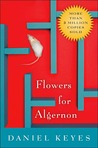
Flowers for Algernon by Daniel Keyes (review by Andrew R. ’17)

Flowers for AlgernonFlowers for Algernon by Daniel Keyes
My rating: 4 of 5 stars

In Daniel Keyes’ beloved short story “Flowers for Algernon,” a mentally retarded adult named Charlie Gordon undergoes a miraculous surgery that nearly triples his IQ, plunging him headfirst into a world of intellectuals even as he comes to terms with his life before the operation. Here, in Keyes’ later novelization of the same narrative, Charlie’s IQ still rockets up at a dangerous pace—but instead of having to accept his shameful past as an adult with the mind of a child, the newly-created genius must also navigate a crushing tide of memories and feelings that his old brain could never have handled. Watching Charlie stumble through his new life, even more confused and emotionally shredded than he had been with his old IQ of 70, is just as tragic as a novel as in the short story format. My only issue is that it was much more difficult to suspend my disbelief about the miraculous surgery and its effects for three hundred pages than it was for thirty. Those who have never read either “Flowers for Algernon” should pick one and get started immediately, but I’m not sure it’s worthwhile to read both variations on the same theme. – Andrew R. ’17

View all my reviews