Tag Archives: Coming of Age

The Meursault Investigation By Kamel Daoud (Review By Jason S. ’25)

The Meursault InvestigationThe Meursault Investigation by Kamel Daoud
My rating: 3 of 5 stars

“The Meursault Investigation takes place in the same world as Albert Camus’s The Stranger, and tells those events from the perspective of the younger brother of the unnamed Arab murdered by Meursault, who published The Stranger upon his release from prison. In its frame story, the reader takes the role of a voiceless college student who interviews Harun, the brother of Meursault’s “unnamed Arab.” The novel gives the “unnamed Arab” his name — Musa — and provides a unique anticolonial Algerian viewpoint on the philosophical side of Camus’s work through the jaded, unreliable narrator’s picaresque experiences as a fence-sitter during the Algerian Revolution.

The Meursault Investigation is a novel I enjoyed much more in concept than execution. My main issue with it was that its attempts to juxtapose Meursault and Harun were too heavy-handed, with Harun’s narrative having blatant parallels to nearly every major scene in Camus’s novel (with varying levels of success). This became especially noticeable pacing-wise in the second half of the book, into which most of Harun’s plot is crammed; I nearly rolled my eyes when I realized that Meriem, Harun’s love interest, was meant to be a foil to Marie Cardona. It was almost too obvious.

Despite this gripe, the book held my attention throughout its relatively short 191 page duration. Two interesting insights into The Stranger struck me in particular: first, regarding the absurdity of ‘just’ violence and the ethics of liberatory war in Harun’s interrogation; and second, a passage in which Harun praises The Stranger despite his hatred of Meursault because its economy of language allowed it to convey the last words of a person close to death. I also greatly enjoyed the attention devoted to Harun and Musa’s mother, who was a deeply complex character and a highlight in a way her counterpart in The Stranger was not.

If you haven’t read it already, I recommend considering this book after you’ve read The Stranger (perhaps in your first semester of AP Literature), just because it’s refreshing to read such a different take on it. Though it has problems, it’s a thought-provoking supplement that relevantly excoriates the blind spots of Camus’s contribution to the Western canon.”

View all my reviews

Twilight By Stephenie Meyer (Review by Kristiyan K. ’27)

Twilight (The Twilight Saga, #1)Twilight by Stephenie Meyer
My rating: 2 of 5 stars

The Twilight Saga by Stephenie Meyers covers the story of Bella Swan, who moves to Forks, Washington at the beginning of the book, where she meets the mysterious and handsome Edward Cullen. She soon discovers he’s a vampire, and they fall deeply in love despite the dangers their relationship brings. Their love story unfolds amidst a world of vampires, werewolves, and supernatural secrets.

The writing in Twilight is just like a rainy day in Forks – dreary, monotonous, and occasionally interrupted by a particularly awkward thunderstorm of dialogue. It is as dull as a brick! Bella Swan, the heroine, is about as exciting as watching paint dry. Her inner monologue is a monotonous loop of “Oh my gosh, he’s so perfect!” that give even the most dedicated and obsessed fans a headache.

Edward Cullen, the vampire heartthrob, is a walking, talking, sparkling contradiction. He’s supposed to be mysterious and brooding, but he comes across as more mannequin than man. His character is about as deep as a puddle, and his perfection is so blinding it’s practically painful to read. It is as if Meyers wanted to create her ultimate fantasy boyfriend, but forgot to add any flaws.

The non-functional love triangle between Bella, Edward, and Jacob Black, Bella’s childhood friend, is a trainwreck of epic proportions. Jacob is initially a sweet, if slightly whiny, kid. But as the series progresses, he transforms into a possessive, overly dramatic stalker. Also, the age difference between Bella and Jacob is super weird. She’s seventeen and he’s fifteen in the first book! I understand that Edward is also over one hundred, but at least he looks and acts like a teenager. The whole love triangle feels forced, especially because Meyers already set up Edward as the main love interest by the time Jacob became mature enough to be considered as an option by Bella. It’s a romantic disaster that’s more likely to make you cringe than swoon…

However, amidst the cringey dialogue and superficial characters, there are a few glimmers of hope. The world-building is surprisingly decent. Meyers creates fascinating, if somewhat illogical, vampire lore that’s intriguing and terrifying. And Alice Cullen, Edward’s psychic sister, is a breath of fresh air with her earnest personality and cool abilities. There are also a few giggle-worthy and cute romantic scenes that strive to redeem the obviously failing love triangle.

Twilight is undeniably a pop-culture phenomenon, and there’s a certain charm to being part of such a massive fandom. It’s like being in your own personal Hogwarts, minus the magic and plus the endless supply of eye-rolls.

So, should you read Twilight? If you’re a masochist with a penchant for the absurd, absolutely. Just be prepared for a rollercoaster of emotions that will leave you simultaneously laughing, cringing, and questioning your life choices.

View all my reviews

Stoner by John Williams (Review by Felix C. ’25)

StonerStoner by John Williams
My rating: 4 of 5 stars

The 1965 novel Stoner, by John Williams, is a masterpiece of mid-century American literature. The work follows the life and academic career of William Stoner, born in 1891 to a farmer in rural Missouri. Stoner is a deeply flawed man — though our protagonist, his choices, actions, and personality are often humanly lacking. Williams’s prose is simple and yet descriptive, neither overly ornate nor without emotion and beauty. From the novel’s very earliest words, I was hooked. The almost exceptionally unexceptional life Stoner lives may dissuade some from reading the work, but the focus Williams gives to this life lifts that which could be excruciatingly dull to an enthralling and engaging work. I wish that Williams had explored those characters whom Stoner had impacted throughout his life in greater depth, but admire his choice to reflect how people move in and out of each others’ lives for fleeting moments. Ultimately, though, the focus of the book is William Stoner: through him, Williams presents the full range of human emotion and experience in one short, unremarkable, but utterly human life.

I would recommend this book to anyone who is looking for a quieter book, one with an engrossing story and thoughtful elements. -Review by Felix C. ’25

View all my reviews

Normal People by Sally Rooney (Review by Varsha R. ’21)

Normal PeopleNormal People by Sally Rooney
My rating: 4 of 5 stars

TW for Normal People: Sexual assault and suicide

The first thing I noticed when I started Sally Rooney’s Normal People was that she does not use quotation marks in dialogue. What was initially jarring became understandable to me over the course of the novel. At the heart of Rooney’s writing is an innate desire to fully immerse the reader into the narrative; in real life, we don’t talk or perceive language with quotation marks, and her aversion towards such conventional punctuation made me feel as though I myself was a side character in the book, watching the story unfold with an outside, yet involved, perspective.

Rooney’s sentences are short, blunt, and zany. At first glance, her words leave almost no room for interpretation, but she also manages to craft an intense, emotionally draining and, at times, frustrating love story that leaves an impact. It’s perhaps for this reason that people either seem to adore Rooney’s writing or despise it. It takes a while to get used to, especially after reading the more standard works of basically any other established author.

Normal People takes a classic, time-and-time-again-told story of misunderstanding amid romance while weaving key threads of social class, mental turmoil, and simultaneous self-discovery and self-depression. It’s impossible not to sympathize with the lead characters, Marianne and Connell, as they make their individual footprints in their legacies while constantly surrounded by the other’s memory and presence.

They start a clandestine relationship with one another in their senior year of high school with the cliche trope of a popular soccer player and a quiet, misunderstood ugly duckling. What separates Normal People from any other coming-of-age romantic comedy is an unmistakable backdrop of social inequality, emotional uncertainty, and poignant thoughts of philosophy and self-questioning, which are furthered by a strong use of the third person.

Rooney has an irksome talent to keep the magnetically attached Marianne and Connell in her books apart at the most inopportune moments, a trope that gets exasperating after the first couple times. But as she puts it, “All these year they’ve been like two little plants sharing the same plot of soil, growing around one another, contorting to make room, taking certain unlikely positions.”

And of course, a key hallmark of Rooney’s books is a disappointing ending that almost came off as a final “screw you” to the reader after having been swept up in Marianne and Connell’s intertwining tale for so long. But it was impossible for me to stay annoyed for long after having reflected on the profound impact that this book had on me, my perception of myself, and my understanding of how I’m perceived in the world around me. —Review by Varsha R. ’21

For those who enjoyed Normal People, Varsha also suggests Conversations with Friends by Sally Rooney and The Outline Trilogy: Outline, Transit and Kudos by Rachel Cusk.

View all my reviews

This Tender Land by William Kent Krueger (Review by Alysa S. ’22)

This Tender LandThis Tender Land by William Kent Krueger
My rating: 4 of 5 stars

This book made me smile and frown and laugh at all the right times. I loved the protagonist Odie’s character development from the moment he undertook a journey of escape towards a better future to the day he returned home, and I also greatly enjoyed the incredibly strong theme of friendship present between the four main characters on the journey.

This Tender Land begins in the rural countryside of Minnesota, and I especially appreciate the author’s accurate historical representation of the Great Depression Era and its socioeconomic effects on the various demographics that we encounter throughout the journey. Although Odie is the main focus of the book, I enjoyed the visibly significant growth of each of the four characters. I think what made this book such a feel-good read was Odie’s relatability as a protagonist: he’s clearly unsure of himself and shoulders immense responsibilities at a young age, but his resilience and inherently caring nature cause me to gravitate towards his character and admire both his strengths and weaknesses.

Though This Tender Land seems occasionally juvenile in its storytelling (understandable from the young protagonist’s POV), for anyone who wants to experience an epic, cross-country adventure while learning a bit of 1930’s history through the eyes of a teenage vagabond stepping into the role of a young adult, this coming-of-age tale proves to be a satisfactory read. —Review by Alysa S. ’22

View all my reviews

Norwegian Wood by Haruki Murakami (Review by Alena S. ’24)

Norwegian WoodNorwegian Wood by Haruki Murakami
My rating: 4 of 5 stars

Norwegian Wood is my comfort book, and not because reading it leaves me feeling warm or happy—but because I love its transparency. This book displays the ugly sides of human nature, yet it hints at tenderness due to how personal it is. Murakami expertly balances the dark themes of mental illness and suicide with humorous scenes, and the main character Toru makes me laugh quite a bit despite not being a funny character. Although the tale is set in the late 60s, it has a universal appeal that doesn’t feel dated, and ironically, despite the precise descriptions of nature and people, something about the story gives it an otherworldly feel.

Since technology was not as advanced nor widespread at the time, people were more in touch with nature, and Murakami’s description of scenery and rain was incredibly beautiful — one of my favorite aspects of the book. Even though this book was really unorthodox in its structure and plot compared to books I’ve read in the past, I rated it four stars because I feel like the protagonist helped me better understand a side of personal struggles and hardships that I hadn’t previously experienced myself. However, the book does go through a lot of poignant and deep discussion about the connection between life and death, and the open ending felt like a sudden and unrealistic rush that left no room for afterthought compared to the heavy plot. —Review by Alena S. ‘24

View all my reviews

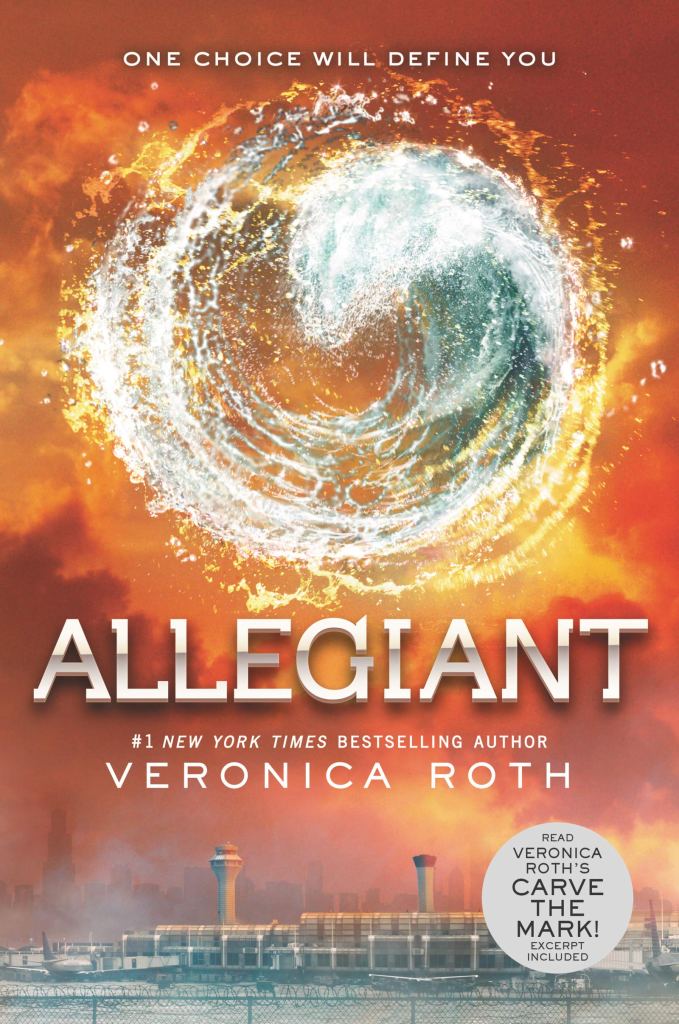
Allegiant: Book to Movie Review (by Ritu B. ‘24)

“I can’t believe that they have desecrated something so sacred!” I burst out as soon as the Allegiant movie credits flashed onto the screen. My family can attest to that.

Let me back up.

In fourth grade, I finished the sumptuous feast that is the Divergent series, books that were so important to me in my childhood. Having been pleased years ago by the first movie adaption of the series, I had high, high hopes coming into the Allegiant movie…that you can already guess were not fulfilled.

[Warning: Reading ahead will reveal spoilers for the Divergent series]

If you’re familiar with the book and you’ve seen the movie, then you already know my largest grievance. Come on, say it with me out loud, and let’s relieve our agony together: orange!!

In the book, the world outside of Chicago is described as gloomy and dark, but in the movie, we get Kraft’s mac-and-cheese-flavored radioactivity!

I have no problem whatsoever with producers taking creative rights with the storyline—if the movie were the same as the book, no one would want to watch it, right?

Wrong.

Little plot meanderings and trimmings here and there will make a movie more enjoyable to sit through, but when it’s obvious that a three hour film won’t do justice to such a heavy book’s plot, then the movie project must be split into two. (Think Harry Potter and The Hunger Games.) Allegiant undoubtedly fell under this category, and I’m devastated that instead of making two films, the movie cut out half of the book’s plot, half of the characters, and hacked away at Veronica Roth’s masterpiece until it arrived at a sloppy post-apocalyptic world.

Uriah who? Cara who? So many members of the crew that accompanied Tris and Tobias out of Chicago weren’t present at all. Instead, the movie blew 90% of its precious duration on slow camera pans to show off “breath-taking”—but really, irrelevant—technology.

However, I did appreciate a few parts—that is, when I wasn’t being blinded by the orange. In spite of the twisted storyline in the movie, the script stayed true to the main characters’ identities. Tobias was Theo James (sorry but I can’t find any flaws with that.) Evelyn, his dictator mother, maintained her redemptive arc in the end, giving up power to be with her son. Peter, the “bad guy” who hangs out with the “good guys,” was sharp, sarcastic, and self-absorbed. My favorite line of the movie was “[t]hat’s why you pick a guy like me for a job like this,” intended for his boss to hear, which he delivers after shooting Evelyn in the knee when she turns back on their dark plan.

But, ok, I’ve reached my last complaint: Tris didn’t die in her quest to restore goodness in the world. This movie doesn’t deserve the name Allegiant if the ending doesn’t plunge its claws into your chest, wrench your heart out, and render you a sobbing shell of a human being for the next week.

Have you watched Allegiant? Share your thoughts in the comments! — Ritu B. ’24

For those who enjoyed this book, Ritu has recommended The Lunar Chronicles series for you to check out!

Cemetery Boys by Aiden Thomas (Review by Anika F. ’21)

Cemetery BoysCemetery Boys by Aiden Thomas
My rating: 4 of 5 stars

If you are looking for an emotional young adult story with paranormal elements, Cemetery Boys is the perfect book for you. Cemetery Boys follows a teenaged transgender male named Yadriel who is trying to prove his identity to his family. After a string of murders, Yadriel decides to summon a ghost with his brujo powers, but ends up summoning the wrong spirit.

The strong points of the book include (but are not limited to) the characters and the culture. When I initially read that the ghost summoned would be the “high school bad boy,” I was convinced that I would not like the character. However, as I read more and more, I found Julian’s personality to be so much more than the synopsis gives him credit for: He is loyal, brave, and accepting while also being funny and sarcastic. Similarly, I found Yadriel’s character to be a delight to follow. His journey with identity is so wonderfully done; you can see his struggles and successes as he proves to his family that he truly is a brujo. Latinx culture is also seamlessly mixed with the story. There are some beautiful scenes about Día de los Muertos, where Yadriel is able to communicate with his ancestors who have passed on. In particular, this book thrives when discussing the intersection of Yadriel’s gender identity and his cultural background.

My main complaint with this book has to do with the predictability of the plot. In essence, the story is a murder mystery where a few men end up dead. I guessed the murderer at around page 50 and was not surprised at all by the ending. My second plot critique does involve some spoilers, but to keep it vague: I like when decisions have consequences. Some of these characters seemed to make tough calls, but not face adequate repercussions.

Do I think these criticisms break the book? Absolutely not. Cemetery Boys is much deeper than the plot. Rather than being about a murder-mystery, this story is about love, identity, and family. And in those aspects, this book truly shines. –Review by Anika F. ’21

For those who enjoyed this book, Anika has recommended Felix Ever After for you to check out!

View all my reviews

Memoirs of a Teenage Amnesiac by Gabrielle Zevin (Review by Ritu B. ’24)

Memoirs of a Teenage AmnesiacMemoirs of a Teenage Amnesiac by Gabrielle Zevin
My rating: 3 of 5 stars

Some books you stay up reading till 3 A.M. because you love them and don’t want to put them down. For others, you’ve spent half the book yelling at the protagonist for being dumb, and (for the sake of your sanity) you need to know what happens next. Memoirs of a Teenage Amnesiac was the latter. Not that that’s a bad thing.

The book raises intriguing questions on identity: If you lost recollection of the last five years, how would you view your current lifestyle?

After falling down the stairs, Naomi loses all her memories from after the sixth grade. Enter an irresistible, rebellious boy who finds her. Throw in a jock boyfriend, parental divorce, a best friend loyal to the point of idiocy, and the ingredients seem very predictable (and perhaps slightly nauseating if you, like me, have consumed enormously more than the healthy amount of YA Fiction). Yet, we keep returning to this genre because we can’t get enough of the awkward, heartwarming teen romance—which you’ll find no dearth of here.

Ultimately, this book won’t change your life, but who even cares. Give it a shot if you want to drown your sorrows in some cliché YA! –Review by Ritu B. ’24

For those who enjoyed this book, Ritu has recommended Crazy Rich Asians for you to check out!

View all my reviews

The Sun Is Also a Star by Nicola Yoon (Review by Lizzie B. ’24)

The Sun Is Also a StarThe Sun Is Also a Star by Nicola Yoon
My rating: 2 of 5 stars

I’d like to preface this by acknowledging that just because I didn’t enjoy it doesn’t mean you won’t. With that having been said, this book single-handedly put me off of reading contemporary for several months.

The Sun Is Also a Star by Nicola Yoon is a contemporary romance novel taking place over the course of a day featuring teenagers Daniel Jae Ho Bae and Natasha Kingsley. They meet through a series of freak coincidences and proceed to fall in love as Daniel follows Natasha around New York City, unaware that this might be her last day in the US. Now let me share my critique.

Firstly, despite all the drama, I could not force myself to care about or like any of the characters. There were some themes that I did enjoy, but the endless stereotypes and unbelievable story overshadowed them. The best segments were the short perspectives of the side characters, as I found them insightful and frankly more interesting than Daniel’s and Natasha’s, but I certainly wouldn’t read the book just for that. Initially, I thought contemporaries might just not be for me but since then I have read several contemporaries that I greatly enjoyed, only furthering the idea for me that this is simply not worth the hype.

Without spoiling the story, there’s not much else to say but honestly, if you’re looking for an inspiring comfort read, I wouldn’t recommend this. It half-heartedly discusses fate to some extent and while I think it might be fun to analyze, it was not fun for me to read. –Review by Lizzie B. ’24


***** 4 STARS *****
Written by Nicola Yoon, The Sun is Also a Star is a novel revolving around two young adults Natasha and Daniel, who fall in love despite the numerous obstacles that come their way. First, Daniel is Korean and Natasha is African-American, which is a racial difference they believe their families would not approve of. Moreover, Natasha is an undocumented immigrant and is to be deported the exact day they meet, forcing the two lovers to separate. Despite the challenges they face, both Natasha and Daniel attempt to make the best of their bad situations. They focus on the present and on each other, cherishing the time they have left together, instead of constantly worrying when they will have to leave each other.

This book is unique and showcases the perspective and thoughts of each character by labeling their names at the top of every page rather than being narrated from only one perspective. This allowed the reader to really feel what the lovers are feeling, and anticipate and fear what will happen to the protagonists. I would definitely recommend this book due to its beautiful concept of how living in the moment is such an important concept that everyone needs to implement in their own lives. – Sachi B. ’21

View all my reviews