Tag Archives: Identity

World and Town by Gish Jen (review by Andrew R. ’17)

World and TownWorld and Town by Gish Jen
My rating: 4 of 5 stars

Gish Jen is a wittier Amy Tan: her novels and stories, usually told through the perspective of first- or second-generation Chinese immigrants to America, fearlessly tackle religious issues, the mystery of death, and the folly of American culture, all without forsaken the signature lightness and incisiveness of her prose. World and Town is split into five narrative sections. One follows Sophy Chung, the daughter of Cambodian immigrants, who takes refuge in fundamentalist Christianity to escape her past sins; another follows Everett, the scorned and scornful backwoods lover of a born-again evangelist. The majority of the book, though, is from the perspective of Hattie (Hăi dì) Kong, an aging immigrant whose existence in the Southern town of Riverlake is somehow more American than any of its native inhabitants. As Hattie struggles with her religion and heritage (and messes with those of her neighbors—she can’t help herself), Riverlake becomes so vivid and complex that it feels as real as life to the reader, and sometimes realer. While Sophy’s and Everett’s narrative voices were not always convincing, World and Town was as a whole engaging, even addictive. Strongly recommended for readers who enjoy having their beliefs challenged and their prejudices called out. – Andrew R. ’17
View all my reviews

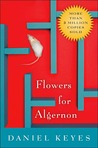
Flowers for Algernon by Daniel Keyes (review by Andrew R. ’17)

Flowers for AlgernonFlowers for Algernon by Daniel Keyes
My rating: 4 of 5 stars

In Daniel Keyes’ beloved short story “Flowers for Algernon,” a mentally retarded adult named Charlie Gordon undergoes a miraculous surgery that nearly triples his IQ, plunging him headfirst into a world of intellectuals even as he comes to terms with his life before the operation. Here, in Keyes’ later novelization of the same narrative, Charlie’s IQ still rockets up at a dangerous pace—but instead of having to accept his shameful past as an adult with the mind of a child, the newly-created genius must also navigate a crushing tide of memories and feelings that his old brain could never have handled. Watching Charlie stumble through his new life, even more confused and emotionally shredded than he had been with his old IQ of 70, is just as tragic as a novel as in the short story format. My only issue is that it was much more difficult to suspend my disbelief about the miraculous surgery and its effects for three hundred pages than it was for thirty. Those who have never read either “Flowers for Algernon” should pick one and get started immediately, but I’m not sure it’s worthwhile to read both variations on the same theme. – Andrew R. ’17

View all my reviews

Four by Veronica Roth (review by Catherine H. ’17)

Four: The Transfer (Divergent, #0.1)Four: The Transfer by Veronica Roth
My rating: 4 of 5 stars

Four is a collection of several short stories that help clarify the background of the character Four in Veronica Roth’s Divergent series. This book has several sections that begin with his Choosing Ceremony and end a short while after he meets Tris. I found this an intriguing read and thought it was nice for a quick read. I would recommend this to anyone who read and enjoyed the Divergent series. – Catherine H. ’17

View all my reviews

Timebound by Rysa Walker (review by Catherine H. ’17)

Timebound (The Chronos Files, #1)Timebound by Rysa Walker
My rating: 4 of 5 stars

Rysa Walker’s Timebound, the first installment in the Chronos Files, is a very thought provoking read. Kate’s grandmother, Katherine, comes to town and announces that she is terminally ill and would like to spend more time with her granddaughter, which seems like a reasonable request. However, Kate’s mother insists that her grandmother is selfish and that she shouldn’t go. But Kate notices a strange medallion that glows a brilliant shade of blue that her mother can’t see but her grandmother can. Upon confronting her grandmother about it, she learns that her massive headaches have been caused by shifts in the timeline and that her grandfather is stuck in a different time, trying to create a religion and change history to benefit himself. Kate also finds out that this medallion is a CHRONOS key that lets her travel back in time. Before she can start training, another shift occurs and her parents disappear from the timeline, having never met each other and never having had her. She must now carry the key with her at all times or else disappear forever. It becomes her mission to go back in time and warn her grandmother so that she can restore her timeline. This book made me think about time travel in a different way. Even though there are several timelines that are mentioned, the story is straightforward and easy to follow. I recommend this book to anyone interested in time travel. – Catherine H. ‘17

View all my reviews

Cat’s Eye by Margaret Atwood (review by Elizabeth S. ’16)

Cat's EyeCat’s Eye by Margaret Atwood
My rating: 5 of 5 stars

Cat’s Eye details the life of stream-of-consciousness narrator Elaine as she reflects as an aged artist on her years growing up in the time after World War II in Toronto. Elaine has recently returned to Toronto in order to manage a retrospective gallery of her own critically acclaimed work. She reconnects with specters from her past, like the phantom Cordelia who tormented her as a child, whom she now sees and hears everywhere she goes even though she is long gone. Atwood captures Elaine’s apathetic, passerby-like thoughts and describes her world in the most visceral way, making her writing a true joy to behold as it brings the story to life. Atwood also uses Elaine as a lens through which she can explore her own judgments and thoughts about growing up as a girl through elementary, middle, high school, and university, finding love, hate, strength, and weakness in all of these events that seem so cataclysmic when undergone for the first time. Cat’s Eye is a true masterpiece, recommended to anyone for a more adult spin on a coming of age story.

View all my reviews

Wintergirls by Laurie Halse Anderson (review by Elizabeth S. ’16)

WintergirlsWintergirls by Laurie Halse Anderson
My rating: 4 of 5 stars

Though intimidating because of its subject matter, Wintergirls yields a reward high enough at the end to make reading it well worthwhile. Anderson’s writing is always visceral and heartbreaking, but the harsh reality of eating disorders makes it even more gritty. When I was not transfixed by the story, I was admiring Anderson’s writing style and the perfect way that she captures the first person speaker, Lia. Lia’s best friend Cassie was recently found dead in a motel room of an overdose. The book details their past together, including Cassie’s bulimia (which eventually led to her downfalll), Lia’s anorexia, and the pact they made together when they were younger. Lia’s anorexia resurfaces, for the guilt that Lia feels about Cassie serves as a trigger. The author’s voice is strong in this book, with truly believable characters and a singular writing style. I recommend this book to any reader looking to really feel for a character and who isn’t at risk of being triggered by the subject matter. – Elizabeth S. ’16

View all my reviews

Glass by Ellen Hopkins (review by Nikita R. ’16)

Glass (Crank, #2)Glass by Ellen Hopkins
My rating: 5 of 5 stars

Suddenly dealt with the responsibilities of motherhood, Kristina Snow must somehow raise a child while battling her addiction to “the monster,” known as crystal meth. Despite her love for her child, Kristina finds herself becoming increasingly dissatisfied with the monotony of her daily life in comparison to the excitement of her past. In Glass, the second sequel in the Crank series, Ellen Hopkins once again brings to life the story of a confused, desperate teenager who has become swept up in a world she is not ready for. Although the average reader has not necessarily shared Kristina’s experiences, any teenager or adult will understand her emotions and decisions. This book is a must-read, for teenagers especially. – Nikita R. ‘16

View all my reviews

Earth Girl by Janet Edwards (review by Monica K. ’14)

Earth Girl (Earth Girl, #1)Earth Girl by Janet Edwards
My rating: 2 of 5 stars

Despite the two star rating, don’t be fooled – Earth Girl features some strong writing, promising world building, and a powerful, independent female lead. The setting has a genuine science fiction feel and is set centuries in the future, long after the first portal and colonization of another planet. In this futuristic society, our protagonist, Jarra, is the one in a thousand born with an immune system unable to handle other planetary atmospheres. As part of an ostracized minority, Jarra decides to get back at society by spending her first year of her history degree in an archaeology course filled with “exos” from offworld planets.

The first half goes from pretty good to stellar (see what I did there?), as Jarra leaves her class in the dust with her history expertise. Unfortunately, the second half stagnates. Descriptions become tediously long, a cringe-worthy decision on the author’s part leaves the last third irritating to read, and in the end the plot fails to move much. However, while I did not like this novel, I still believe that Janet Adams is a promising writer and would recommend Earth Girl to fans of Ender’s Game and the like. – Monica K. ‘14

View all my reviews

The Rise of Renegade X by Chelsea Campbell (review by Monica K. ’14)

The Rise of Renegade X (Renegade X, #1)The Rise of Renegade X by Chelsea Campbell
My rating: 5 of 5 stars

I would just like to say: The Rise of Renegade X is a seriously cool read, whether you’re a hardcore comic book fanatic, a lover of The Avengers/Thor/the next major superhero movie, or none of the above. Set in Metroville, the city with the highest concentration of superheroes and villains in the US, the novel introduces a world where every young hero and villain gains their power, their acceptance in respective training academies, and a H or V on their left thumb on their sixteenth birthday. Damien Locke is just one of the many villain hopefuls waiting for his sixteenth birthday. However, he is in for a nasty surprise when an X instead of a V materializes on his thumb. The novel follows his crazy adventures as he finds love, the true identify of his father, and his own true self as well. Even with its refreshing, hilarious take on superhero mythology, the element of the novel that really carries the story is Damien’s warped, obnoxious, highly entertaining personality. Highly recommended to fans of the superhero genre and those in the mood for a fast-paced, engaging read. – Monica K. ‘14

View all my reviews

Middlesex by Jeffrey Eugenides (review by Meilan S. ’17)

MiddlesexMiddlesex by Jeffrey Eugenides
My rating: 5 of 5 stars

Middlesex, by Jeffery Eugenides, is a book that crosses boundaries. Not only is the subject matter, the story of a pseudohermaphrodite, Callie/Cal struggling with self-identity, fresh, but the book also encompasses several genres. It begins as a historical novel as we explore the lives of Callie/Cal’s parents and grandparents. It shows the scientific side of his condition, as well as how it affects him emotionally, from confusing crushes to the hybrid emotions he feels when trying to be a girl. Furthermore, it is told in an uncommon narrative voice: first person omniscient, which adds to the fresh feel of the novel. The book is an enthralling masterpiece, and despite the extraordinary events that unfold, Eugenides is able to keep it grounded with Callie/Cal’s narration, which is extremely relatable and realistic. Without a doubt, Middlesex is a fantastic book, and I whole-heartedly recommend it to anyone looking for an exciting and satisfying literary journey. – Meilan S. ’17

View all my reviews